Frequently Asked Questions
The most-asked questions about particle and nuclear physics.
What is particle and nuclear physics in a nutshell?
Particle physics studies the smallest known constituents of matter and the forces that govern them, while nuclear physics focuses on the structure and behavior of atomic nuclei. Together they form the framework for understanding how the universe works at its most fundamental scales.
Who are the most iconic figures in the field?
Names like Ernest Rutherford, who first mapped the atomic nucleus, and Niels Bohr, whose model reshaped atomic theory, anchor the early history. In the modern era, Richard Feynman, Murray Gell-Mann, and Peter Higgs are among the most celebrated for their work on quantum field theory, quarks, and the Higgs mechanism.
What is the Standard Model of particle physics?
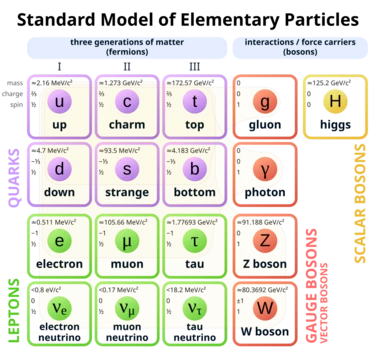
It is the theoretical framework that catalogues all known elementary particles—quarks, leptons, and gauge bosons—and describes three of the four fundamental forces. It has been confirmed by experiment to extraordinary precision but does not yet account for gravity or dark matter.
How is particle physics different from nuclear physics?
Nuclear physics deals with protons, neutrons, and the forces binding them inside nuclei, while particle physics pushes further to examine what those nucleons themselves are made of. In practice the two overlap heavily, especially in areas like nuclear reactions and neutrino studies.
What is the Higgs boson and why did its discovery matter?
It is a particle associated with the Higgs field, which gives mass to fundamental particles through their interaction with it. Its detection at CERN's LHC in 2012 confirmed the last missing piece predicted by the Standard Model and earned Peter Higgs and François Englert the Nobel Prize.
What are the four fundamental forces?
They are gravity, electromagnetism, the strong nuclear force, and the weak nuclear force. Three of them are described by quantum field theory within the Standard Model, while gravity is still described by general relativity and has not yet been unified with the others.
What is CERN and what does the LHC do?
CERN is a European research laboratory near Geneva where scientists build and operate large particle accelerators. The Large Hadron Collider smashes protons and heavy ions at near-light speed to recreate conditions similar to the early universe and probe the properties of fundamental particles.
What is antimatter and why is it important?
Antimatter consists of particles that mirror ordinary matter—each has the same mass but opposite charge, such as the positron being the electron's antiparticle. When matter and antimatter meet they annihilate into pure energy, a process central to PET scanning and a key puzzle in cosmology about why the universe is matter-dominated.
Where should a newcomer start learning?
A solid introductory textbook on modern physics or quantum mechanics, paired with a popular-science book like Brian Cox's 'Why Does E=mc²?', gives both the math and the intuition. Online resources such as CERN's open-access articles and university lecture series provide free, up-to-date explanations of current research.
What are some of the most notable milestone moments in the field?
Rutherford's gold-foil experiment in 1911 revealed the nucleus, Chadwick's discovery of the neutron in 1932 opened the door to nuclear energy, and the 2012 Higgs boson confirmation capped nearly five decades of searching. More recently, the detection of gravitational waves in 2015 and ongoing neutrino-oscillation studies continue to reshape our picture of the universe.