Physics beyond the Standard Model
Theoretical developments addressing the Standard Model's deficiencies.
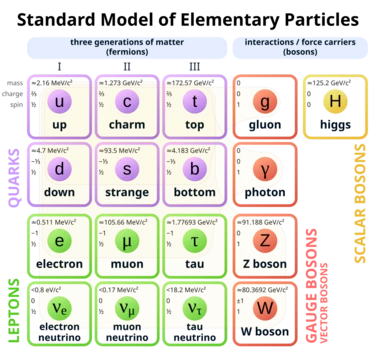
Physics beyond the Standard Model (BSM) encompasses the theoretical frameworks required to resolve the known shortcomings of the Standard Model of particle physics. A primary issue is that the Standard Model cannot account for several fundamental physical phenomena observed in nature. It does not incorporate gravity, and its mathematical structure is incompatible with general relativity; both theories break down under extreme conditions such as the Big Bang or at black hole event horizons. The Standard Model also fails to explain the nature of dark matter and dark energy, which together constitute the vast majority of the universe's mass-energy, with the Standard Model only accounting for about five percent. Attempts to explain dark energy as vacuum energy from the Standard Model produce a mismatch of 120 orders of magnitude. Additionally, the Standard Model cannot account for neutrino oscillations, which imply neutrinos have mass—a property the Standard Model does not provide. While mass terms can be added, they are extraordinarily small and raise new theoretical problems. The observed matter–antimatter asymmetry of the universe is another deficiency, as the Standard Model predicts nearly equal amounts of both. Although baryogenesis via sphalerons is possible, the resulting imbalance may be insufficient. The strong CP problem and the inability to explain the model's own fundamental parameters are further gaps. Proposed BSM theories include supersymmetric extensions like the Minimal Supersymmetric Standard Model and Next-to-Minimal Supersymmetric Standard Model, as well as string theory, M-theory, and extra dimensions. Because these theories all reproduce existing phenomena, determining which represents the correct step toward a Theory of Everything requires experimental testing, making this one of the most active areas in theoretical and experimental physics.
- field
- Theoretical and experimental physics
- known_for
- Proposing extensions to the Standard Model, such as supersymmetry, string theory, M-theory, and extra dimensions
- key_problems
- Gravity, dark matter, dark energy, neutrino oscillations, matter–antimatter asymmetry, cosmic inflation
Lore & Background
The Standard Model, despite being the most successful theory of particle physics, is inherently incomplete. It does not explain gravity, and its mathematical framework is inconsistent with general relativity, breaking down at spacetime singularities like the Big Bang and black hole event horizons. Phenomena such as neutrino oscillations, which require neutrinos to have mass, and the observed matter–antimatter asymmetry in the universe are not accounted for by the Standard Model. Dark matter and dark energy, which together constitute about 95% of the universe's mass-energy, also lack explanation within the Standard Model.
Reader's Guide
Physics beyond the Standard Model is significant because it represents the frontier of fundamental physics, seeking to resolve the known shortcomings of the Standard Model. The Standard Model cannot explain gravity, dark matter, dark energy, neutrino oscillations, or the matter–antimatter asymmetry of the universe. It is also inconsistent with general relativity. BSM theories, such as supersymmetric extensions and string theory, attempt to provide a more complete framework. The legacy of BSM research lies in its drive to unify all fundamental forces and particles, with experimental tests at colliders and other facilities determining which theoretical path is correct. The ongoing search for new physics, evidenced by anomalies like the B meson decay excess and the neutron lifetime puzzle, underscores the dynamic and unresolved nature of this field. Ultimately, BSM research shapes the direction of both theoretical and experimental physics, aiming for a deeper understanding of the universe.
Did You Know?
- The Standard Model explains only about 5% of the mass-energy in the universe, with dark matter and dark energy making up the rest.
- The neutron lifetime puzzle shows a 10-second difference between bottle and beam measurement methods.
Frequently Asked Questions
What is Physics beyond the Standard Model?
BSM is the umbrella term for theoretical and experimental work aimed at fixing what the Standard Model simply cannot explain. It encompasses proposals such as supersymmetry, string theory, M-theory, and extra-dimensional models that extend the current particle-physics framework.
What problems does BSM try to solve?
The Standard Model leaves major gaps, including the identity of dark matter and dark energy, neutrino oscillations, the matter–antimatter asymmetry, and the strong CP problem. BSM theories attempt to address all of these within a single coherent framework.
What are the most famous BSM proposals?
Supersymmetry (SUSY), string theory, M-theory, and models featuring extra spatial dimensions are the best-known candidates. Each offers a distinct mechanism for unifying forces or introducing new particles and symmetries beyond the quark–lepton–boson roster.
Why is BSM important to the physics community?
Without BSM, we cannot reconcile quantum mechanics with general relativity, explain why the observable universe contains far more matter than antimatter, or identify what dark matter actually is. It represents the next essential step in our understanding of fundamental reality.
How does BSM connect to gravity and cosmology?
A core motivation is bridging the mathematical incompatibility between the Standard Model and general relativity, especially at extreme energy scales. Phenomena like cosmic inflation and the cosmological constant (dark energy) further push physicists to look beyond the current model.
More in Particle And Nuclear Physics 1-24
Spotted an error? Know more?
This is a living reference — every entry is fact-audited, and reader corrections feed straight into our audit queue. Suggest an edit · See this site's audit record