Fermion
Subatomic particles with half-integer spin obeying Pauli exclusion.

A fermion is a subatomic particle that follows Fermi–Dirac statistics, has half-integer spin, and obeys the Pauli exclusion principle. Fermions include all quarks and leptons, as well as composite particles made of an odd number of these, such as baryons and many atoms and nuclei. They are usually associated with matter, while bosons are generally force carrier particles, though the distinction is unclear in current particle physics.
- field
- Particle physics
- known_for
- Following Fermi–Dirac statistics, half-integer spin, obeying Pauli exclusion principle
- types
- Elementary (quarks, leptons) and composite (e.g., protons, neutrons)
- named_by
- Paul Dirac, from the surname of Enrico Fermi
Lore & Background
The name 'fermion' was coined by English theoretical physicist Paul Dirac from the surname of Italian physicist Enrico Fermi. Fermions are defined by their half-integer spin and their adherence to Fermi–Dirac statistics, as opposed to bosons which obey Bose–Einstein statistics. According to the spin-statistics theorem in relativistic quantum field theory, particles with half-integer spin are fermions, while those with integer spin are bosons. In addition to spin, fermions possess conserved baryon or lepton quantum numbers, but the spin-statistics theorem relates spin to statistics, not to conserved quantum numbers.
Reader's Guide
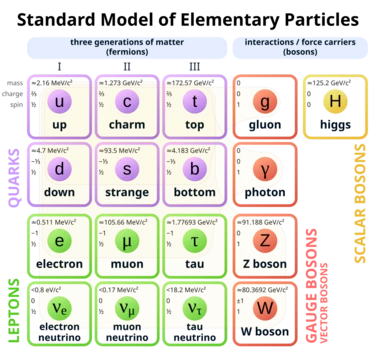
Fermions are fundamental to the structure of matter. The Standard Model recognizes 24 elementary fermions: six quarks (up, down, strange, charm, bottom, top) and six leptons (electron, electron neutrino, muon, muon neutrino, tau, tau neutrino), each with a corresponding antiparticle. Composite fermions, such as protons and neutrons, are the key building blocks of everyday matter. The Pauli exclusion principle dictates that only one fermion can occupy a particular quantum state at a given time, which governs the behavior of electrons in atoms and the stability of matter. Under extreme conditions, weakly interacting fermions can display bosonic behavior, such as superfluidity in uncharged particles and superconductivity in charged particles. The three most common mathematical types of fermions are Weyl (massless), Dirac (massive), and Majorana (each its own antiparticle). Most Standard Model fermions are believed to be Dirac fermions, though it is unknown whether neutrinos are Dirac or Majorana.
Did You Know?
- Fermions include all quarks and leptons and all composite particles made of an odd number of these.
- The name 'fermion' was coined by Paul Dirac from the surname of Enrico Fermi.
- Fermions can exhibit bosonic behavior when they become bound in pairs, as in superconductivity and superfluidity of helium-3.
The Two Faces of Massless Gauge Bosons
The Standard Model identifies two gauge bosons expected to carry zero invariant mass: the photon and the gluon. The photon, the messenger of electromagnetism, stands apart as the sole particle whose masslessness has been directly verified through observation. Its existence and zero rest mass are beyond dispute in modern physics. The gluon, by contrast, occupies a more tentative position. It is the carrier of the strong nuclear force, and its existence has been inferred indirectly from the decay products of high-energy particle collisions. While compelling theoretical arguments point toward a zero mass for the gluon, no experiment has ever confirmed this directly. The fundamental obstacle is confinement: gluons are permanently bound inside hadrons and can never be isolated as free, observable particles. This means that, for all practical purposes, the gluon's presumed masslessness remains an elegant theoretical expectation rather than an experimentally settled fact, a distinction that continues to matter in precision tests of the Standard Model.
The Graviton: A Particle That May Not Exist
Among the most tantalizing gaps in particle physics is the question of whether gravity has a quantum particle carrier at all. The graviton is proposed in certain quantum theories of gravity as a hypothetical tensor boson that would mediate the gravitational interaction, much as the photon mediates electromagnetism. However, no quantum theory of gravity has yet been successfully woven into the framework of the Standard Model. Consequently, the Standard Model neither predicts the graviton's existence nor demands it as a necessary component. To date, no experiment has produced any indication of a gravitational quantum particle. Beyond the question of whether the graviton exists in the first place, there is an additional layer of uncertainty: even if such a particle were someday detected, whether it would possess zero invariant mass remains entirely an open question. The graviton thus occupies a uniquely speculative corner of physics, where the very premises of its existence and its fundamental properties are both unresolved.
Weyl Fermions: The Quasiparticle Illusion
In 2015, physicists announced the discovery of Weyl fermions, a finding that initially seemed to add a new class of massless particles to the known roster. In reality, these Weyl fermions are not fundamental particles at all. They are quasiparticles—collective, composite motions that arise within the crystalline structure of molecular lattices and exhibit particle-like behavior without being genuine elementary entities. They are analogous to phonons, which represent quantized vibrations in a solid rather than free-standing particles. No actual fundamental particle has ever been identified as a true Weyl fermion, and there is no compelling theoretical principle that demands their existence in the particle spectrum. This distinction matters because it means the Weyl fermion, despite its elegant name and the excitement surrounding its 2015 discovery, does not alter the count of confirmed massless elementary particles. It is a fascinating emergent phenomenon in condensed matter physics, but it does not belong in the same category as the photon or any other Standard Model particle.
Neutrinos: From Massless Dream to Nobel-Winning Mass
For much of the twentieth century, neutrinos were widely assumed to be massless, and some theorists even speculated they might be genuine Weyl fermions—the one type of fundamental particle that would be inherently massless. That picture shattered with the discovery of neutrino oscillation, the phenomenon in which neutrinos change flavor as they propagate through space. Oscillation is only possible if at least two of the three neutrino types possess nonzero mass, which immediately ruled out the Weyl-fermion possibility for any of them. The experimental confirmation of this behavior was so significant that it earned Canadian physicist Arthur B. McDonald and Japanese physicist Takaaki Kajita the 2015 Nobel Prize in Physics. The broader implication was profound: with neutrinos confirmed as massive, no fundamental particle of the Weyl type remained in the known particle inventory. The Weyl fermion, once a candidate for a real massless elementary particle, was left with only its quasiparticle manifestations in condensed matter systems, a quiet reminder of how a single experimental discovery can reshape an entire theoretical landscape.
Frequently Asked Questions
Who is Fermion?
A fermion is a class of subatomic particle defined by its half-integer spin and its adherence to Fermi–Dirac statistics. The name was given by Paul Dirac as a tribute to the Italian physicist Enrico Fermi.
What are Fermion's powers and role in the universe?
Fermions serve as the fundamental constituents of matter, covering all quarks, all leptons, and any composite particle built from an odd number of those (such as protons and neutrons). Their defining trait is the Pauli exclusion principle, which forbids two identical fermions from occupying the same quantum state at once.
How does Fermion's story stand in modern physics?
In the current Standard Model, the once-sharp line separating fermions from bosons has grown fuzzier, since both are now described as excitations of quantum fields. Nevertheless, fermions still account for essentially all the stable matter we encounter in the everyday world.
Why is Fermion so important to the physical universe?
Without fermions there would be no atoms, no nuclei, and no solid matter, because they are the particles that actually make up the material world. The Pauli exclusion principle also gives matter its volume, preventing electrons in atoms from all piling into the lowest energy level.
What types of Fermion exist?
Elementary fermions are the six quarks and the three lepton generations (electron, muon, tau, plus their three neutrinos). Composite fermions appear whenever an odd number of these combine, yielding baryons, many atomic nuclei, and numerous atoms.
More in Particle And Nuclear Physics 1-24
Elsewhere in the Particle And Nuclear Physics universe
Spotted an error? Know more?
This is a living reference — every entry is fact-audited, and reader corrections feed straight into our audit queue. Suggest an edit · See this site's audit record