Proton
Proton: stable subatomic particle, building block of atomic nuclei.

A proton is a stable subatomic particle with a positive electric charge of +1 e. Protons and neutrons, each with a mass of about one dalton, are jointly referred to as nucleons. One or more protons are present in the nucleus of every atom, providing the attractive electrostatic central force that binds atomic electrons. The number of protons in the nucleus is the defining property of an element, known as the atomic number.
- symbol
- p, H+, 1H+
- charge
- +1 e
- classification
- composite particle, hadron, baryon
- composition
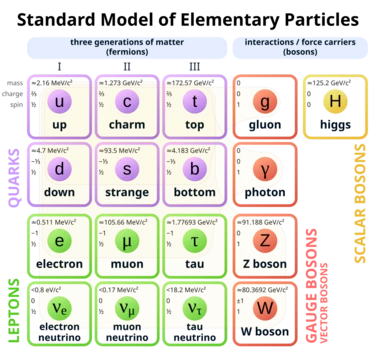
- two up quarks, one down quark
- discoverer
- Ernest Rutherford
Lore & Background
The concept of a hydrogen-like particle as a constituent of other atoms was developed over a long period. Later that year J. J. Thomson determined a value for the electric charge and showed canal rays included material with charge-to-mass ratio consistent with the hydrogen ion.
Reader's Guide
The proton is fundamental to the structure of matter. As the nucleus of the most common hydrogen isotope, and a constituent of all other atomic nuclei, the proton defines each element through its atomic number. Although originally considered elementary, the modern Standard Model shows protons are composite particles containing three valence quarks held together by gluons via the strong force. The proton's stability is a key assumption in physics; while spontaneous decay has never been observed, some grand unified theories predict lifetimes between 10^31 and 10^36 years, with experimental lower bounds exceeding 10^34 years for certain decay modes. Free protons occur naturally in cosmic rays, plasmas, and thunderstorms, and are used in accelerators for proton therapy and particle physics experiments, such as the Large Hadron Collider. The proton's role in binding electrons and forming nuclei underpins chemistry and the structure of the universe.
Did You Know?
- Protons are composed of two up quarks of charge +2/3 e each and one down quark of charge -1/3 e.
- The rest masses of quarks contribute only about 1% of a proton's mass; the remainder is due to quantum chromodynamics binding energy.
- Free protons make up 90% of cosmic rays, which propagate through the interstellar medium.
Frequently Asked Questions
What is a proton?
A proton is a stable, positively charged subatomic particle that serves as a core building block of every atomic nucleus. It carries a charge of +1 elementary charge and is classified as a composite hadron and baryon.
What is a proton made of?
A proton is bound from three quarks: two up quarks and one down quark held together by the strong nuclear force. This internal quark arrangement is what gives the particle its net +1 e charge.
Why does the proton count in a nucleus matter?
The number of protons in the nucleus is the defining property of a chemical element, known as the atomic number. The proton's positive charge also generates the electrostatic central force that attracts and binds atomic electrons around the nucleus.
More in Particle And Nuclear Physics 1-24
Elsewhere in the Particle And Nuclear Physics universe
Spotted an error? Know more?
This is a living reference — every entry is fact-audited, and reader corrections feed straight into our audit queue. Suggest an edit · See this site's audit record