Muon
A heavy electron that reshaped particle physics.

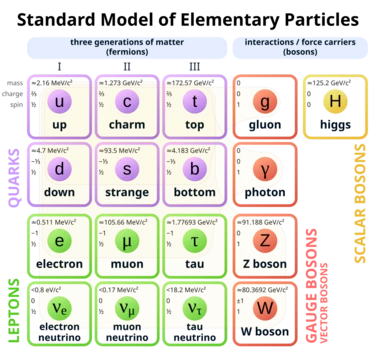
The muon is an elementary particle classified as a lepton, similar to the electron but with a much greater mass. It is unstable, with a mean lifetime of 2.2 μs, and decays via the weak interaction, always producing an electron (or positron) and two types of neutrinos. Muons are denoted by μ−, and their antiparticles, antimuons, by μ+. Formerly called mu mesons, they are no longer classified as mesons by modern particle physicists.
- type
- Elementary particle (lepton)
- charge
- −1 e (muon); +1 e (antimuon)
- spin
- 1/2 ħ
- mean_lifetime
- 2.2 μs
- discovered_by
- Carl D. Anderson and Seth Neddermeyer
Lore & Background
Muons were discovered by Carl D. Anderson noticed particles that curved differently from electrons and other known particles when passed through a magnetic field; they were negatively charged but curved less sharply than electrons, suggesting a mass between that of an electron and a proton. Anderson initially called the new particle a mesotron. C. Street and E. C. Stevenson's cloud chamber experiment. Because of its mass, the mu meson was initially thought to be the particle predicted by theorist Hideki Yukawa, and some scientists, including Niels Bohr, originally named it the yukon. Yukawa's predicted particle, the pi meson, was finally identified in 1947. With the development of the Standard Model in the 1970s, muons were recognized as fundamental leptons, not composed of quarks, and the term mu meson was abandoned. The muon was the first particle of the second generation of elementary particles to be discovered.
Reader's Guide
The muon's significance lies in its role as a fundamental lepton, providing a heavier counterpart to the electron and serving as a key particle in the second generation of the Standard Model. Its discovery challenged existing theories, as it was initially mistaken for Yukawa's predicted meson mediating the nuclear force, but experiments later showed it did not interact via the strong nuclear force. This led to the famous quip by Nobel laureate I. I. Rabi: 'Who ordered that?', reflecting the surprise at finding a seemingly unnecessary heavy electron. Muons are produced in high-energy interactions, such as cosmic rays hitting the atmosphere, where pions decay into muons. Because of their greater mass, muons emit less bremsstrahlung and can penetrate far deeper into matter than electrons, reaching Earth's surface and even deep mines. This property makes them useful for studying relativistic effects like time dilation, as demonstrated in the Rossi–Hall experiment. The muon's legacy includes clarifying the distinction between leptons and hadrons, and its decay properties—always producing an electron and two neutrinos—helped refine the understanding of the weak interaction. Today, muons are used in particle physics experiments and in applications such as muon tomography, though the source article does not detail the latter.
Did You Know?
- Muons were originally called mu mesons, but are no longer classified as mesons by modern particle physicists.
- The muon's mean lifetime is 2.2 μs, and its decay always produces an electron (or positron) and two types of neutrinos.
Frequently Asked Questions
What are Muon's powers and role?
Muon interacts electromagnetically much like an electron but, being far more massive, is more sensitive to certain quantum and radiative corrections. It also participates in the weak interaction, which is the channel through which it ultimately decays.
How does Muon's story end?
Muon is unstable, surviving on average only about 2.2 microseconds before it decays via the weak force. Its decay always produces an electron (or a positron for the antimuon) together with two neutrinos, effectively handing its charge off to a lighter lepton.
Why is Muon important to particle physics?
When cosmic-ray showers in the 1930s revealed a particle that looked like a heavy electron, it was initially mistaken for the long-sought Yukawa meson, creating a major confusion in the field. Correctly identifying it as a new lepton expanded the known particle family and sharpened our understanding of the weak interaction.
More in Particle And Nuclear Physics 1-24
Elsewhere in the Particle And Nuclear Physics universe
Spotted an error? Know more?
This is a living reference — every entry is fact-audited, and reader corrections feed straight into our audit queue. Suggest an edit · See this site's audit record