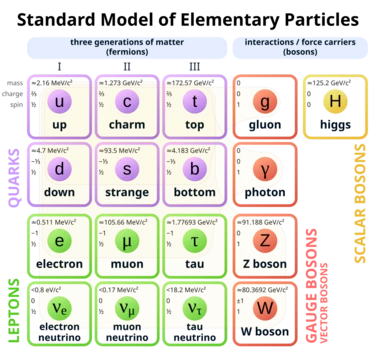
Gluon
Massless vector boson mediating the strong interaction.

A gluon is a type of massless elementary particle that mediates the strong interaction between quarks, acting as the exchange particle for the interaction. Gluons are massless vector bosons with a spin of 1. Through the strong interaction, gluons bind quarks into groups according to quantum chromodynamics (QCD), forming hadrons such as protons and neutrons. Gluons carry the color charge of the strong interaction, thereby participating in the strong interaction as well as mediating it.
- parity
- Parity is defined by gauge-dependent field transformation properties, not as an intrinsic quantum number
Lore & Background
Together with the quarks, these particles were referred to as partons by Richard Feynman. Gluons carry both color and anticolor, giving nine possible combinations of color and anticolor, but only eight independent types exist because the color singlet state is forbidden. The stable strongly interacting particles, including hadrons like the proton or the neutron, are observed to be colorless, and gluons in the singlet state do not exist.
Reader's Guide
Gluons are fundamental to the strong force, binding quarks into hadrons such as protons and neutrons. Because gluons themselves carry color charge, they participate in strong interactions, leading to gluon–gluon interactions that constrain color fields to string-like objects called flux tubes. This confinement effectively limits the range of the strong interaction to about 10⁻¹⁵ m, roughly the size of a nucleon. Beyond a certain distance, it becomes energetically more favorable to pull a quark–antiquark pair out of the vacuum rather than increase the length of the flux tube. Gluons are not directly involved in the nuclear forces between hadrons; the force mediators for these are other hadrons called mesons. It is predicted that there exist hadrons formed entirely of gluons, called glueballs, though none have been demonstrated. At extreme temperatures and pressures, a quark–gluon plasma forms, where quarks and gluons become free particles. Experimental observations, including three-jet events at DESY and later at LEP, confirmed the spin = 1 nature of the gluon. The gluon density in the proton has been measured by experiments at HERA.
Did You Know?
- Gluons carry the color charge of the strong interaction, unlike photons in QED which carry no electric charge.
- There are eight independent types of gluons in QCD, corresponding to the dimension of the adjoint representation of SU(3).
- Gluons do not have a fixed intrinsic parity; as gauge-dependent vector bosons, parity is defined by field transformation properties.
The Glue That Holds the Nucleus Together
Murray Gell-Mann gave this particle its name in 1962, borrowing the everyday image of adhesive holding objects together. The gluon is, in essence, the quantum glue that keeps the atomic nucleus intact. As a massless vector boson with a spin of one, it serves as the exchange particle for the strong interaction, the force that binds quarks into composite groups called hadrons, including the familiar proton and neutron. Richard Feynman later grouped quarks and gluons under the umbrella term "partons," reflecting their shared role as the fundamental constituents of nuclear matter.
Although the gluon is theoretically massless, a requirement imposed by the gauge invariance of quantum field theory, experiments place an upper bound on any possible rest mass at just a few MeV per c². Because it is massless, the gluon possesses only two polarization states rather than three; the field's polarization must remain transverse to its direction of travel. It also carries a negative intrinsic parity, a property that shapes how it participates in scattering and decay processes.
Carrying the Charge: Why QCD Is Harder Than QED
A defining feature that sets the gluon apart from the photon is that it carries the color charge of the strong interaction itself. In quantum electrodynamics, the photon mediates the electromagnetic force yet carries no electric charge, so photons do not interact with one another. The gluon, by contrast, both mediates the strong force and participates in it, meaning gluons can interact with other gluons. This self-coupling makes quantum chromodynamics far more analytically challenging than QED.
Quarks come in three types of color charge, while antiquarks carry three corresponding anticolors. A gluon carries one color and one anticolor simultaneously, yielding nine possible color–anticolor pairings in principle. Yet only eight of these combinations are truly independent, a fact rooted in the underlying SU(3) gauge symmetry. That single missing ninth state, the color singlet, is excluded by the structure of the theory, leaving exactly eight gluon types and a web of self-interactions that keeps the strong force locked inside composite particles.
Confinement, Flux Tubes, and the Glueball
Because gluons carry color charge, they interact with one another as well as with quarks. These gluon–gluon interactions force the color field into narrow, string-like structures known as flux tubes, which exert a roughly constant pulling force as they are stretched. This is the mechanism behind quark confinement: quarks are trapped inside composite particles called hadrons, and the effective range of the strong interaction is limited to about 10⁻¹⁵ meters, roughly the size of a single nucleon. If two quarks are pulled far enough apart, the energy stored in the stretched flux tube grows linearly until it becomes energetically cheaper to spawn a new quark–antiquark pair from the vacuum than to keep stretching the tube.
A striking consequence is that gluons do not directly mediate the residual nuclear force between hadrons; that role belongs to mesons. Nevertheless, theorists predict exotic hadrons called glueballs, in which the bound state consists entirely of real gluons rather than quarks, offering a window into the gluon's self-interacting nature.
The Mathematics of Eight: SU(3) and the Color Octet
Quantum chromodynamics is built on an SU(3) gauge symmetry. Quarks are introduced as spinors in the fundamental representation, a triplet denoted 3, while gluons live in the adjoint representation, an octet denoted 8. For any SU(n) gauge group, the number of force-carrier bosons equals n² − 1, which for n = 3 gives exactly eight gluons. This stands in contrast to the single photon of QED or the three W and Z bosons of the weak interaction.
The nine naive color–anticolor combinations reduce to eight independent states because one particular linear combination, the color singlet (red–antired plus blue–antiblue plus green–antigreen, divided by the square root of three), is excluded. The theory's SU(3) structure, rather than a larger U(3) group, forbids this ninth state. Had the symmetry been U(3), that extra gluon would behave like a second photon, free to travel long distances, which experiments do not support. The eight remaining states are linearly independent, equivalent to the Gell-Mann matrices, and no combination of them can reconstruct the forbidden singlet.
Frequently Asked Questions
What is a gluon?
A gluon is a massless, spin-1 elementary particle that acts as the exchange boson for the strong nuclear force, holding quarks together inside composite particles.
What are the key properties of a gluon?
Gluons are massless vector bosons with spin 1. Unlike photons, they carry color charge, meaning they both mediate and participate in the strong interaction.
How do gluons bind quarks into hadrons?
Within the framework of quantum chromodynamics, gluons are exchanged between quarks, generating the strong force that groups quarks into bound states like protons and neutrons.
Why is the gluon important?
Gluons are responsible for the strong interaction that confines quarks into hadrons, making them essential to the structure of all ordinary matter.
Can gluons interact with other gluons?
Yes — because gluons themselves carry color charge, they self-interact through the strong force, a property that has no direct counterpart in electromagnetism.
More in Particle And Nuclear Physics 1-24
Elsewhere in the Particle And Nuclear Physics universe
Spotted an error? Know more?
This is a living reference — every entry is fact-audited, and reader corrections feed straight into our audit queue. Suggest an edit · See this site's audit record