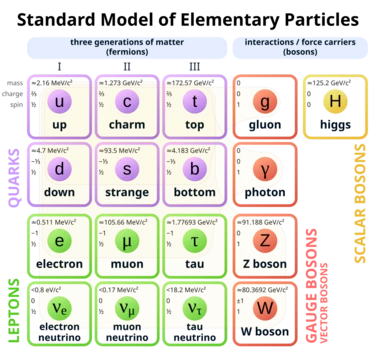
Quark
Elementary particles that form protons, neutrons, and all hadrons.

A quark is a type of elementary particle and a fundamental constituent of matter. Quarks combine to form composite particles called hadrons, the most stable of which are protons and neutrons, the components of atomic nuclei. All commonly observable matter is composed of up quarks, down quarks, and electrons. Owing to a phenomenon known as color confinement, quarks are never found in isolation; they can be found only within hadrons, which include baryons (such as protons and neutrons) and mesons, or in quark–gluon plasmas.
- field
- Particle physics
- known_for
- Fundamental constituent of matter; only elementary particles to experience all four fundamental interactions; electric charges not integer multiples of elementary charge
Lore & Background
The quark model was independently proposed by physicists Murray Gell-Mann and George Zweig in 1964. At the time, the 'particle zoo' included a multitude of hadrons; Gell-Mann and Zweig posited that they were composed of combinations of quarks and antiquarks. Their model involved three flavors of quarks: up, down, and strange. The initial reaction of the physics community was mixed, with contention about whether the quark was a physical entity or a mere abstraction. Deep inelastic scattering experiments conducted in 1968 at the Stanford Linear Accelerator Center (SLAC) showed that the proton contained much smaller, point-like objects. Physicists were reluctant to firmly identify these objects with quarks at the time, instead calling them 'partons'—a term coined by Richard Feynman. The objects observed at SLAC would later be identified as up and down quarks. The strange quark's existence was indirectly validated by SLAC's scattering experiments, providing an explanation for the kaon and pion hadrons discovered in cosmic rays in 1947.
Reader's Guide
Quarks are the only elementary particles in the Standard Model to experience all four fundamental interactions: electromagnetism, gravitation, strong interaction, and weak interaction. They are also the only known particles whose electric charges are not integer multiples of the elementary charge. There are six flavors of quarks: up, down, charm, strange, top, and bottom. Up and down quarks have the lowest masses and are generally stable and the most common in the universe; heavier quarks rapidly change into up and down quarks through particle decay and can only be produced in high energy collisions. Quarks are spin-1/2 particles, meaning they are fermions subject to the Pauli exclusion principle. They possess color charge, which causes them to engage in the strong interaction, leading to the formation of hadrons. The quark model revolutionized particle physics by providing an ordering scheme for hadrons and explaining the composition of matter at its most fundamental level.
Did You Know?
- Quarks are never found in isolation due to color confinement; they exist only within hadrons or quark–gluon plasmas.
- There are six types, known as flavors, of quarks: up, down, charm, strange, top, and bottom.
- The quark model was independently proposed by Murray Gell-Mann and George Zweig in 1964.
- Deep inelastic scattering experiments at SLAC in 1968 provided the first evidence for the physical existence of quarks.
Frequently Asked Questions
What is a quark?
A quark is an elementary particle that serves as one of the fundamental building blocks of all matter. It is unique among known elementary particles in that it experiences all four fundamental forces at once.
What role do quarks play in the universe?
Quarks bind together to form hadrons, with protons and neutrons being the most stable and familiar examples. Every atomic nucleus you can observe is ultimately constructed from up and down quarks held in place by the strong interaction.
Can a quark ever be found on its own?
No. A phenomenon called color confinement means quarks are permanently locked inside composite states such as baryons, mesons, or quark–gluon plasmas, and no isolated quark has ever been detected.
What makes quarks different from other elementary particles?
Quarks carry fractional electric charges—multiples of one-third the elementary charge—rather than the whole-integer charges seen on electrons or muons. They also come in six distinct flavors, giving them a richer variety than most other particle families.
Why are quarks considered so central to physics?
Without quarks, protons and neutrons could not form, which would make atomic nuclei—and therefore all ordinary matter—impossible. They sit at the very foundation of the Standard Model's description of matter.
More in Particle And Nuclear Physics 1-24
Elsewhere in the Particle And Nuclear Physics universe
Spotted an error? Know more?
This is a living reference — every entry is fact-audited, and reader corrections feed straight into our audit queue. Suggest an edit · See this site's audit record