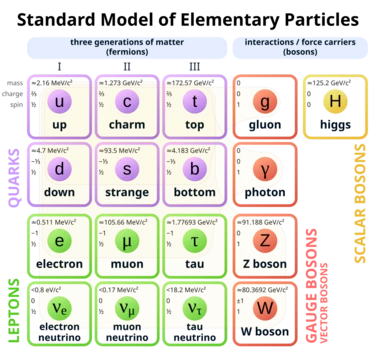
Gauge boson
Force-carrying bosons that mediate fundamental interactions.

Gauge bosons are bosonic elementary particles that act as force carriers for elementary fermions. They are the quanta of gauge fields in quantized gauge theories, and their interactions are described by gauge theory, typically as virtual particles. All known gauge bosons have a spin of 1, making them vector bosons, and they are distinct from other bosons such as the scalar Higgs boson, composite mesons, and larger composite bosons like certain atoms.
- types
- Photon, W and Z bosons, gluons
Lore & Background
In the Standard Model of particle physics, 12 gauge bosons are recognized: 1 photon, 8 gluons, and 3 W/Z bosons (W+, W-, Z0). Photons carry the electromagnetic interaction; W and Z bosons carry the weak interaction; and gluons carry the strong interaction. Isolated gluons do not occur because they are color-charged and subject to color confinement. The number of gauge bosons corresponds to the number of generators of the gauge field: quantum electrodynamics (U(1)) has one gauge boson (the photon), quantum chromodynamics (SU(3)) has eight gluons, and the electroweak theory (SU(2)_L × U(1)_Y) gives rise to the three W and Z bosons after symmetry breaking, not from SU(2) alone. Gauge invariance requires that gauge bosons be massless at a naïve theoretical level, but the W and Z bosons gain mass via the Higgs mechanism. In this mechanism, the four gauge bosons of the unified electroweak interaction couple to a Higgs field, which undergoes spontaneous symmetry breaking due to the shape of its interaction potential. The resulting non-zero Higgs vacuum expectation value couples to three of the electroweak gauge bosons (W+, W−, and Z), giving them mass, while the photon remains massless. This theory also predicts the existence of a scalar Higgs boson, which has been observed in experiments at the LHC. Beyond the Standard Model, grand unification theories such as the Georgi–Glashow model predict additional gauge bosons named X and Y bosons, which would mediate interactions between quarks and leptons, violating baryon number conservation and causing proton decay. No evidence of X and Y bosons has been found. The hypothetical graviton, if it exists, may carry gravity, but it is unknown whether it would be a gauge boson. W′ and Z′ bosons are hypothetical new gauge bosons named in analogy with the Standard Model W and Z bosons.
Reader's Guide
Gauge bosons are fundamental to the Standard Model of particle physics, serving as the mediators of three of the four known fundamental forces: electromagnetism (photons), the weak force (W and Z bosons), and the strong force (gluons). Their existence and properties are central to understanding how elementary fermions interact. The requirement that gauge bosons be massless under gauge invariance posed a theoretical conflict with the short range of the weak and strong interactions, resolved by the Higgs mechanism, which gives mass to the W and Z bosons while leaving the photon massless. This mechanism also predicted the Higgs boson, later observed at the LHC. The multiplicity of gauge bosons reflects the structure of the underlying gauge groups, with eight gluons for SU(3) and three electroweak bosons for SU(2). Beyond the Standard Model, hypothetical gauge bosons like X and Y bosons in grand unified theories and W′ and Z′ bosons extend the framework, though experimental evidence remains absent. The graviton, if it exists, may or may not be a gauge boson, highlighting ongoing uncertainty in quantum gravity. Gauge bosons thus underpin both established physics and speculative extensions, shaping our understanding of fundamental forces.
Did You Know?
- All known gauge bosons have a spin of 1 and are therefore vector bosons.
- Isolated gluons do not occur because they are color-charged and subject to color confinement.
- The W and Z bosons gain mass via the Higgs mechanism, while the photon remains massless.
- The Georgi–Glashow model predicts hypothetical X and Y bosons that would cause proton decay.
The Force-Carrying Identity of Gauge Bosons
In the architecture of particle physics, gauge bosons occupy a singular role: they are the elementary messengers through which fundamental fermions exert forces upon one another. Whenever two particles interact via a gauge theory, the exchange happens through the temporary appearance of a virtual gauge boson, a quantum of the underlying gauge field. The Standard Model recognizes exactly four such carriers—the photon for electromagnetism, the W and Z bosons for the weak force, and the gluons for the strong force. Every one of them carries a spin of one, earning them the label vector boson, which sets them apart from the spin-zero Higgs boson or the hypothetical spin-two graviton. Gauge bosons also stand apart from other categories of bosons: they are not composite mesons made of quarks, not fundamental scalar bosons, and not larger non-force-carrying bosonic atoms. Their defining feature is purely functional—they exist to transmit the fundamental interactions that bind the subatomic world together.
The Mass Paradox and the Higgs Resolution
At first glance, the mathematics of gauge invariance seems to demand that every gauge boson be massless. Introducing a mass term into the field equations would add extra contributions to the Lagrangian under gauge transformations, breaking the very symmetry that defines the theory. If taken at face value, this would mean all fundamental forces are long-ranged. Yet experiments clearly show that the weak and strong interactions operate only over extremely short distances. The Standard Model resolves this tension through the Higgs mechanism. In this framework, the four gauge bosons associated with the unified electroweak symmetry group couple to a Higgs field whose interaction potential drives spontaneous symmetry breaking. The result is a non-zero vacuum expectation value that permeates all of space. Three of the four electroweak bosons—the W+, W−, and Z—acquire mass through their coupling to this background field, while the photon remains massless. The same theory also predicts a scalar Higgs boson, which was later confirmed in experiments at the Large Hadron Collider.
Counting the Bosons: Gauge Groups and Multiplicity
In any quantized gauge theory, the number of gauge bosons is not arbitrary—it is dictated by the algebraic structure of the underlying gauge group. Specifically, there is one gauge boson for every generator of that group. In quantum electrodynamics, the gauge group is the simple U(1), which has a single generator, yielding exactly one gauge boson: the photon. Quantum chromodynamics is considerably richer. Its gauge group, SU(3), possesses eight generators, and correspondingly there are eight distinct gluons. In the electroweak sector, the three W and Z bosons map roughly onto the three generators of the SU(2) group. This multiplicity carries direct physical consequences. Because gluons themselves carry color charge, they are subject to color confinement and never appear as isolated particles in nature. The photon, by contrast, is electrically neutral and can propagate freely, which is why electromagnetic effects are observable at macroscopic scales while strong-force effects remain confined and never manifest as free particles.
Speculative Extensions: Bosons Beyond the Standard Model
The Standard Model's roster of gauge bosons may be incomplete. Grand unification theories, such as the Georgi–Glashow model, predict the existence of additional heavy bosons called X and Y. These hypothetical particles would mediate interactions between quarks and leptons, a process that violates baryon number conservation and would lead to proton decay. Because of the symmetry-breaking scale at which they would emerge, X and Y bosons would be far more massive than the W and Z. Despite extensive searches, including data from the Super-Kamiokande neutrino detector, no experimental evidence for these particles has been found. Gravity presents another open question. The graviton, if it exists, would carry the fourth fundamental interaction, but without a mathematically consistent theory of quantum gravity, it remains unknown whether the graviton qualifies as a gauge boson. The analogous symmetry in general relativity is diffeomorphism invariance. Finally, hypothetical W′ and Z′ bosons have been proposed as new gauge bosons beyond the Standard Model, named in direct analogy with their familiar counterparts.
Frequently Asked Questions
What exactly is a gauge boson?
A gauge boson is an elementary boson that acts as the messenger particle for fundamental forces between fermions. In quantum field theory it represents the quantized excitation of a gauge field, and it typically appears as a virtual particle during interactions.
What types of gauge bosons exist?
The known gauge bosons include the photon (electromagnetic force), the W and Z bosons (weak nuclear force), and the gluons (strong nuclear force). Together they mediate three of the four fundamental interactions in nature.
What spin do gauge bosons carry?
Every confirmed gauge boson has a spin of 1, which classifies them as vector bosons. This distinguishes them from scalar bosons like the Higgs, which carry spin 0.
How are gauge bosons different from other bosons?
While all gauge bosons are bosons, not all bosons are gauge bosons. The Higgs boson, mesons, and even certain composite atomic systems are bosons but do not function as force carriers in the gauge-theory sense.
Why are gauge bosons important in physics?
Gauge bosons are central to the Standard Model because they are the mechanism through which elementary fermions interact via the electromagnetic, weak, and strong forces. Without them, the framework of gauge theory that underpins modern particle physics would have no physical carriers.
More in Particle And Nuclear Physics 1-24
Elsewhere in the Particle And Nuclear Physics universe
Spotted an error? Know more?
This is a living reference — every entry is fact-audited, and reader corrections feed straight into our audit queue. Suggest an edit · See this site's audit record