Meson
Unstable hadrons composed of a quark and an antiquark.

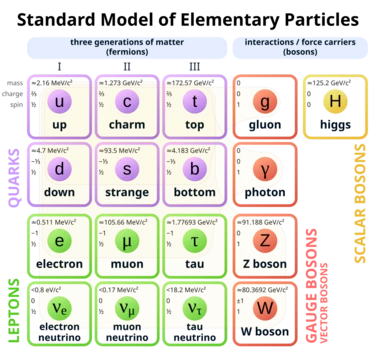
Mesons are a type of hadronic subatomic particle composed of an equal number of quarks and antiquarks, usually one of each, bound together by the strong interaction. They have a diameter of roughly one femtometre, about 0.6 times the size of a proton or neutron, and all mesons are unstable, with the longest-lived lasting only a few tenths of a nanosecond. Mesons are part of the hadron particle family, which also includes baryons, and they participate in both the weak and strong interactions.
- type
- Hadronic subatomic particle
- composition
- Equal number of quarks and antiquarks (usually one of each)
- size
- Diameter roughly one femtometre (10⁻¹⁵ m)
- stability
- All unstable; longest-lived lasts a few tenths of a nanosecond
- spin
- Bosons (integer spin) due to quark-antiquark pair
- interactions
- Strong and weak interactions; electrically charged mesons also participate in electromagnetic interaction
Lore & Background
Yukawa called his carrier particle the meson, from μέσος mesos, the Greek word for 'intermediate', because its predicted mass was between that of the electron and that of the proton.
Reader's Guide
Although the actual carrier of the strong force is now believed to be the gluon, mesons such as the pion are still used as approximate models for the nuclear force between protons and neutrons. Mesons are routinely produced artificially in particle accelerators and appear in nature only as short-lived products of high-energy collisions, such as cosmic rays. They are classified by quark content, spin, parity, and other properties, and heavier mesons decay to lighter ones, ultimately to stable electrons, neutrinos, and photons. The lightest mesons are less massive than the lightest baryons, making them easier to produce and study in experiments.
Did You Know?
- Mesons have a diameter of roughly one femtometre, about 0.6 times the size of a proton or neutron.
- The first true meson discovered was the pion, identified in 1947 by Cecil Powell and others using photographic films placed in the Andes mountains.
- The J/Psi meson, containing the charm quark, is about three times as massive as a proton.
- Mesons are bosons because they consist of a quark and an antiquark, each with spin 1/2, resulting in integer total spin.
Frequently Asked Questions
What is a meson in particle physics?
A meson is a hadronic subatomic particle built from an equal number of quarks and antiquarks, most commonly a single quark–antiquark pair held together by the strong force. It sits alongside baryons (like protons and neutrons) in the broader hadron family, but its quark content is fundamentally different.
What is a meson made of?
In its simplest form a meson is one quark bound to one antiquark by the strong interaction. Because the pair carries integer spin, every meson is classified as a boson rather than a fermion.
How long does a meson last before decaying?
All mesons are unstable; even the longest-lived species survive for only a few tenths of a nanosecond before falling apart. This extreme transience is one of the key reasons mesons are studied in high-energy collisions rather than in stable matter.
How big is a meson compared to a proton?
A meson's diameter is roughly one femtometre (10⁻¹⁵ m), which works out to about 60 % of a proton's or neutron's size. The compactness reflects how tightly the strong force squeezes the quark–antiquark pair together.
Which fundamental forces act on mesons?
Mesons take part in both the strong and weak nuclear interactions, and any meson that carries an electric charge also couples to the electromagnetic force. Together these three quantum interactions fully describe how mesons are created, scatter, and decay.
More in Particle And Nuclear Physics 1-24
Elsewhere in the Particle And Nuclear Physics universe
Spotted an error? Know more?
This is a living reference — every entry is fact-audited, and reader corrections feed straight into our audit queue. Suggest an edit · See this site's audit record