Quantum field theory
Framework combining field theory, relativity, and quantum mechanics.
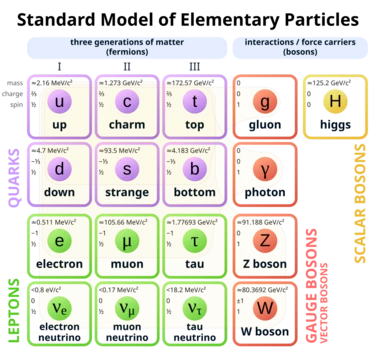
Quantum field theory (QFT) is a framework in theoretical physics that merges classical field theory, special relativity, and quantum mechanics. It provides the foundation for modeling subatomic particles in particle physics and quasiparticles in condensed matter physics, and it underpins the Standard Model of particle physics.
The development of QFT spanned much of the 20th century, beginning in the 1920s with efforts to describe interactions between light and electrons, which led to the first QFT—quantum electrodynamics. Soon after, calculations in perturbative approaches produced persistent infinities, a problem solved in the 1950s through the invention of renormalization. A later obstacle arose when QFT seemed unable to account for weak and strong interactions, prompting some physicists to consider abandoning field theory entirely. The rise of gauge theory and the completion of the Standard Model in the 1970s revived the field.
QFT builds on three earlier theories. The first successful classical field theory emerged from Newton’s law of universal gravitation, though Newton himself described gravity as instantaneous action at a distance. In correspondence, he called such action inconceivable without some mediating non-material substance. In the 18th century, mathematicians introduced fields—numerical quantities assigned to every point in space—to describe gravity, but this was seen as a mere trick. Fields gained physical reality in the 19th century with electromagnetism. Michael Faraday coined the term "field" in 1845, treating fields as properties of space with physical effects, and argued against action at a distance, proposing interactions occur via space-filling lines of force. James Clerk Maxwell completed classical electromagnetism in 1864 with equations linking electric and magnetic fields, electric current, and charge. These equations predicted electromagnetic waves traveling at the speed of light, refuting action at a distance.
Classical electromagnetism could not explain atomic spectral lines or blackbody radiation. Max Planck’s study of blackbody radiation launched quantum mechanics: he treated atoms as tiny oscillators whose energies take only discrete values—quantum harmonic oscillators—a process called quantization. In 1905, Albert Einstein explained the photoelectric effect by proposing light consists of discrete energy packets called photons, showing electromagnetic radiation behaves as both waves and particles. Niels Bohr’s 1913 atomic model introduced discrete electron energies, another quantization example, explaining spectral lines. In 1924, Louis de Broglie proposed wave–particle duality for microscopic particles. These ideas coalesced into quantum mechanics between 1925 and 1926, with contributions from Planck, de Broglie, Heisenberg, Born, Schrödinger, Dirac, and Pauli.
Also in 1905, Einstein published special relativity, built on Maxwell’s electromagnetism. It introduced Lorentz transformations, which change how time and space coordinates shift with observer velocity, blurring the distinction between time and space. Physical laws were required to be invariant under these transformations for observers at different velocities.
Two problems remained. The Schrödinger equation explained stimulated emission—where an electron emits a photon under an external field—but could not explain spontaneous emission, where an electron emits a photon without an external field.
- field
- Theoretical physics
- known_for
- Combining field theory, special relativity, and quantum mechanics; basis of the Standard Model
Lore & Background
Quantum field theory emerged from the work of generations of theoretical physicists spanning much of the 20th century. Its development began in the 1920s with the description of interactions between light and electrons, culminating in the first quantum field theory—quantum electrodynamics. A major obstacle soon followed with infinities in perturbative calculations, resolved in the 1950s with the invention of renormalization. A second barrier came with QFT's apparent inability to describe weak and strong interactions, leading some theorists to call for abandoning the field theoretic approach. The development of gauge theory and the completion of the Standard Model in the 1970s led to a renaissance of quantum field theory. The theoretical background of QFT includes classical field theory, quantum mechanics, and special relativity. Classical field theory began with Newton's law of universal gravitation, though fields were initially considered a mathematical trick.
Reader's Guide
Quantum field theory is significant as the theoretical framework underlying the Standard Model of particle physics, which describes subatomic particles and their interactions. The theory overcame major obstacles: infinities in calculations were addressed by renormalization in the 1950s, and the inability to describe weak and strong interactions was resolved by gauge theory and the completion of the Standard Model in the 1970s. QFT also applies to condensed matter physics for modeling quasiparticles. Its legacy includes unifying quantum mechanics and special relativity, and providing a consistent description of electromagnetic, weak, and strong forces. The theory's development involved contributions from many physicists over decades, and it remains central to modern physics.
Did You Know?
- Quantum field theory emerged from the work of generations of theoretical physicists spanning much of the 20th century.
- The first quantum field theory was quantum electrodynamics, developed in the 1920s.
- A major obstacle in QFT was the appearance of infinities in perturbative calculations, resolved in the 1950s with renormalization.
- The development of gauge theory and the completion of the Standard Model in the 1970s led to a renaissance of quantum field theory.
Frequently Asked Questions
Who is Quantum field theory?
QFT is the overarching theoretical framework in particle physics that unifies classical field theory, special relativity, and quantum mechanics into a single coherent structure. It serves as the foundational language for describing subatomic particles and their interactions.
What are Quantum field theory's powers/role?
QFT constructs the mathematical models behind the Standard Model of particle physics and also describes quasiparticles in condensed matter systems. It lets physicists predict how particles are created, destroyed, and interact at the deepest accessible level.
How does Quantum field theory's story end?
QFT has no narrative ending—it remains the active, evolving backbone of modern theoretical physics. Its ongoing frontier involves reconciling it with quantum gravity and extending beyond the Standard Model.
Why is Quantum field theory important?
Without QFT, the Standard Model of particle physics would have no mathematical foundation, and we could not systematically describe how fundamental forces operate. It is the indispensable bridge between quantum mechanics and relativistic field descriptions.
What does Quantum field theory combine?
It weaves together three pillars—classical field theory, special relativity, and quantum mechanics—into one unified formalism. This synthesis is what allows it to describe particles as excitations of underlying quantum fields moving through spacetime.
More in Particle And Nuclear Physics 1-24
Spotted an error? Know more?
This is a living reference — every entry is fact-audited, and reader corrections feed straight into our audit queue. Suggest an edit · See this site's audit record