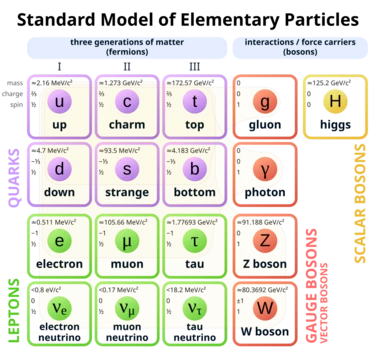
Standard Model
Theory of three fundamental forces and elementary particles.
The Standard Model of particle physics explains three of the four fundamental forces—electromagnetic, weak, and strong—but not gravity. It also catalogs every known elementary particle. The theory took shape over the second half of the 20th century, with contributions from researchers around the globe. Its modern form was set in the mid-1970s, after experiments confirmed the existence of quarks. Later discoveries—the top quark in 1995, the tau neutrino in 2000, and the Higgs boson in 2012—strengthened the model. It has also accurately predicted properties of weak neutral currents and the W and Z bosons.
Despite its internal consistency and experimental successes, the Standard Model is not a complete theory of fundamental interactions. It does not explain why matter outnumbers antimatter, nor does it incorporate general relativity or account for the universe’s accelerating expansion, often attributed to dark energy. It lacks a viable dark matter particle and, in its simplest form, does not include neutrino oscillations or nonzero neutrino masses, though extensions have been proposed to address these gaps.
The model’s development was driven by both theorists and experimentalists. As a quantum field theory, it showcases phenomena like spontaneous symmetry breaking, anomalies, and non-perturbative behavior. It also serves as a foundation for more speculative models involving hypothetical particles, extra dimensions, or symmetries like supersymmetry, aimed at explaining results that deviate from the Standard Model, such as dark matter and neutrino oscillations.
**Historical background**
In 1928, Paul Dirac’s equation suggested the existence of antimatter. In 1954, Yang Chen-Ning and Robert Mills extended gauge theory from abelian groups (as in quantum electrodynamics) to nonabelian groups to describe strong interactions. In 1957, Chien-Shiung Wu showed that parity is violated in the weak interaction. In 1961, Sheldon Glashow unified the electromagnetic and weak forces. In 1964, Murray Gell-Mann and George Zweig introduced quarks, and Oscar W. Greenberg implicitly proposed the color charge of quarks. In 1967, Steven Weinberg and Abdus Salam added the Higgs mechanism to Glashow’s electroweak theory, giving it its modern form.
In 1970, Glashow, John Iliopoulos, and Luciano Maiani devised the GIM mechanism, predicting the charm quark. In 1973, David Gross, Frank Wilczek, and David Politzer independently discovered asymptotic freedom in nonabelian gauge theories like the strong force’s color theory. In 1971, Gerard ’t Hooft proved that gauge theories, including Yang–Mills, could be renormalized. In 1976, Martin Perl found the tau lepton at SLAC. In 1977, a team led by Leon Lederman at Fermilab discovered the bottom quark.
The Higgs mechanism is thought to give mass to all elementary particles in the Standard Model, including the W and Z bosons and the fermions (quarks and leptons). After neutral weak currents from Z boson exchange were detected at CERN in 1973, the electroweak theory gained wide acceptance, earning Glashow, Salam, and Weinberg the 1979 Nobel Prize. The W± and Z⁰ bosons were found in 1983, with their mass ratio matching predictions. The strong interaction theory (quantum chromodynamics, or QCD) took its modern form in 1973–74, when asymptotic freedom was proposed and experiments confirmed that hadrons consist of fractionally charged quarks.
The term “Standard Model” was coined by Abraham Pais and Sam Treiman in 1975, referring to the electroweak theory with four quarks. Steven Weinberg later said he first used the term in a 1973 talk in Aix-en-Provence, France, choosing it out of modesty.
**Particle content**
The Standard Model includes several classes of elementary particles, distinguished by properties like color charge. All particles are summarized as follows:
Notes: [†] An anti-electron (e⁺) is called a positron.
**Fermions**
The model contains 12 spin-½ particles called fermions. They obey the Pauli exclusion principle, meaning two identical fermions cannot occupy the same quantum state in an atom. Each fermion has an antiparticle with opposite charges. Fermions are divided into quarks and leptons based on their interactions, which depend on the charges they carry. Within each group, particles with similar behaviors are arranged into three generations (see table). Each generation’s particles are more massive than those of the previous generation. First-generation particles do not decay, so they make up all ordinary (baryonic) matter. For instance, all atoms consist of electrons and quarks that form protons and neutrons.
- field
- Particle physics
- known_for
- Describing electromagnetic, weak, and strong interactions; classifying all known
Lore & Background
The Standard Model was developed through contributions from many scientists. In 1928, Paul Dirac introduced the Dirac equation, implying antimatter. In 1954, Yang Chen-Ning and Robert Mills extended gauge theory to nonabelian groups to provide an explanation for strong interactions. In 1957, Chien-Shiung Wu demonstrated parity was not conserved in the weak interaction. In 1961, Sheldon Glashow combined the electromagnetic and weak interactions. In 1964, Murray Gell-Mann and George Zweig introduced quarks, and that same year Oscar W. Greenberg implicitly introduced color charge of quarks. In 1967, Steven Weinberg and Abdus Salam incorporated the Higgs mechanism into Glashow's electroweak interaction, giving it its modern form. In 1970, Glashow, John Iliopoulos, and Luciano Maiani introduced the GIM mechanism, predicting the charm quark. In 1973, Gross, Wilczek, and Politzer independently discovered that non-Abelian gauge theories have asymptotic freedom. In 1971, Gerard 't Hooft showed that gauge theories could be renormalized. In 1976, Martin Perl discovered the tau lepton at the SLAC. In 1977, a team led by Leon Lederman at Fermilab discovered the bottom quark. The term "Standard Model" was introduced by Abraham Pais and Sam Treiman in 1975, with reference to the electroweak theory with four quarks.
Reader's Guide
The Standard Model is a paradigm of a quantum field theory for theorists, exhibiting a wide range of phenomena, including spontaneous symmetry breaking, anomalies, and non-perturbative behavior. It has predicted with great accuracy the various properties of weak neutral currents and the W and Z bosons. After the neutral weak currents caused by Z boson exchange were discovered at CERN in 1973, the electroweak theory became widely accepted and Glashow, Salam, and Weinberg shared the 1979 Nobel Prize in Physics for discovering it. The W± and Z0 bosons were discovered experimentally in 1983; the ratio of their masses was found to be as the Standard Model predicted. Experimental confirmations include the top quark (1995), the tau neutrino (2000), and the Higgs boson (2012). However, it leaves phenomena unexplained, such as why there is more matter than anti-matter, it does not incorporate the full theory of gravitation as described by general relativity, or account for the universe's accelerating expansion as possibly described by dark energy. The model does not contain any viable dark matter particle that possesses all of the required properties deduced from observational cosmology. The Standard Model without modifications also does not incorporate neutrino oscillations and their non-zero masses, but extensions have been proposed that can account for these features. It is used as a basis for building more exotic models that incorporate hypothetical particles, extra dimensions, and elaborate symmetries (such as supersymmetry) to explain experimental results at variance with the Standard Model, such as the existence of dark matter and neutrino oscillations.
Did You Know?
- The term 'Standard Model' was introduced by Abraham Pais and Sam Treiman in 1975, with reference to the electroweak theory with four quarks.
- In 1957, Chien-Shiung Wu demonstrated parity was not conserved in the weak interaction.
- The Higgs mechanism is believed to give rise to the masses of all the elementary particles in the Standard Model, including the W and Z bosons and the fermions.
- In 1973, Gross, Wilczek, and Politzer independently discovered that non-Abelian gauge theories have asymptotic freedom.
- The W± and Z0 bosons were discovered experimentally in 1983, and the ratio of their masses was found to be as the Standard Model predicted.
A Century of Incremental Breakthroughs
The Standard Model did not arrive as a single revelation but rather as a layered construction spanning nearly five decades. Paul Dirac's 1928 equation first hinted at antimatter's existence, setting the stage for everything that followed. In 1954, Yang and Mills pushed gauge theory beyond abelian groups, laying groundwork for describing the strong force. Chien-Shiung Wu's 1957 parity-violation experiment shattered assumptions about the weak interaction. Sheldon Glashow then unified electromagnetic and weak forces in 1961, while Gell-Mann and Zweig introduced quarks in 1964, with Greenberg simultaneously implying color charge. Weinberg and Salam gave the electroweak theory its definitive shape in 1967 by weaving in the Higgs mechanism. The 1970s brought the GIM mechanism predicting charm, asymptotic freedom from Gross, Wilczek, and Politzer, and 't Hooft's proof of renormalizability. The very name "Standard Model" was coined by Pais and Treiman in 1975, though Weinberg later claimed he used it as early as 1973 in Aix-en-Provence.
The Architecture of Elementary Particles
At the heart of the Standard Model sit twelve spin-½ fermions, each obeying the Pauli exclusion principle so that no two identical copies can share the same quantum state. Every fermion is mirrored by an antiparticle carrying opposite charges. These twelve divide into two families—quarks and leptons—organized into three generations of increasing mass. The six quarks (up, down, charm, strange, top, bottom) bear color charge and therefore feel the strong force. First-generation particles are stable and build all ordinary baryonic matter: electrons circle nuclei made of up and down quarks. Second- and third-generation charged particles, by contrast, decay in fractions of a second and survive only in high-energy settings. Neutrinos across all three generations never decay and flood the cosmos, yet they interact so weakly with matter that they pass through Earth almost undetected. The Higgs mechanism, woven into the theory, is responsible for endowing the W and Z bosons as well as all quarks and leptons with their observed masses.
A Track Record of Striking Predictions
Few theories in physics can match the Standard Model's experimental hit rate. It predicted with remarkable precision the properties of weak neutral currents and the W and Z bosons before either was observed. When CERN detected neutral weak currents in 1973, the electroweak framework was cemented, and Glashow, Salam, and Weinberg shared the 1979 Nobel Prize. In 1983, the W± and Z0 bosons were finally confirmed, and their mass ratio matched the model's prediction exactly. The strong-interaction theory, quantum chromodynamics, reached its modern form in 1973–74 when asymptotic freedom was established and experiments verified that hadrons are built from fractionally charged quarks. Subsequent decades delivered further confirmations: the top quark in 1995, the tau neutrino in 2000, and the Higgs boson in 2012. Each discovery closed another gap in the particle roster and reinforced confidence that the theory's internal logic tracks the real world with extraordinary fidelity.
The Boundaries of the Known
For all its elegance, the Standard Model is explicitly incomplete. It accounts for three of the four fundamental forces, leaving gravity and general relativity entirely outside its scope. It offers no explanation for why the observable universe contains far more matter than antimatter, nor does it include a viable dark-matter particle with the properties demanded by cosmological observations. The accelerating expansion of the universe, possibly driven by dark energy, also falls beyond its explanatory reach. In its unmodified form, the model cannot accommodate neutrino oscillations or the non-zero masses that experiments have revealed, though extensions have been proposed to patch this gap. The theory nonetheless serves as a launching pad: physicists build more exotic frameworks on top of it, introducing supersymmetry, extra dimensions, and hypothetical particles to address the phenomena the Standard Model leaves untouched. As a quantum field theory, it remains a paradigm showcasing spontaneous symmetry breaking, anomalies, and non-perturbative behavior.
Frequently Asked Questions
Who is Standard Model?
The Standard Model is the central theoretical framework of particle physics that organizes every known elementary particle and explains three of the four fundamental forces in nature. It was not the product of a single author but rather the cumulative achievement of many physicists working through the latter half of the twentieth century.
What are Standard Model's powers/role?
It describes the electromagnetic, weak, and strong interactions and provides a complete catalogue of confirmed elementary particles, from quarks and leptons to the gauge bosons that mediate forces. Notably, it has no mechanism for gravity, dark matter, or neutrino mass within its original structure.
How does Standard Model's story end?
Its current arc reaches a clear boundary: it successfully unifies three fundamental forces but leaves gravity entirely outside its mathematical scope. The open search for a deeper unifying theory means the narrative is still ongoing rather than concluded.
Why is Standard Model important?
It is the most precisely tested theory in all of science, with collider-experiment predictions matching observations to extraordinary accuracy. Virtually every result from facilities like the LHC is interpreted through its formalism, making it the indispensable lens for subatomic research.
When and how was Standard Model finalized?
The modern formulation solidified in the mid-1970s, triggered by the 1974 discovery of the J/psi particle, which confirmed the existence of the charm quark and accelerated the development of quantum chromodynamics. Prior to that milestone, the theory had been assembled piece by piece over several decades of global collaboration.
More in Particle And Nuclear Physics 1-24
Related in Particle And Nuclear Physics
Links follow this subject's own source article.
Spotted an error? Know more?
This is a living reference — every entry is fact-audited, and reader corrections feed straight into our audit queue. Suggest an edit · See this site's audit record