Large Hadron Collider
World's largest and highest-energy particle accelerator.

The Large Hadron Collider (LHC) is the world's largest and highest-energy particle accelerator. It was built by the European Organization for Nuclear Research (CERN) between 1998 and 2008, in collaboration with over 10,000 scientists and hundreds of universities and laboratories across more than 100 countries. It lies in a tunnel 27 kilometres (17 mi) in circumference and as deep as 175 metres (574 ft) beneath the France–Switzerland border near Geneva. The first collisions were achieved in 2010 at an energy of 3.5 TeV per beam, about four times the previous world record. The discovery of the Higgs boson at the LHC was announced in 2012.
- location
- France–Switzerland border near Geneva
- circumference
- 27 kilometers (17 miles)
- depth
- up to 175 meters (574 feet)
- construction_period
- 1998–2008
- first_collisions
- 2010
- highest_beam_energy
- 6.5 TeV per beam (13.0 TeV total)
- key_discovery
- Higgs boson (2012)
Verified Timeline
Lore & Background
The collider is contained in a circular tunnel, with a circumference of 26.7 kilometres (16.6 mi), at a depth ranging from 50 to 175 metres (164 to 574 ft) underground. The 3.8-metre-wide concrete-lined tunnel, constructed between 1983 and 1988, was formerly used to house the Large Electron–Positron Collider. The tunnel crosses the border between Switzerland and France at four points, with most of it in France. The collider tunnel contains two adjacent parallel beamlines, each containing a beam traveling in opposite directions. The beams intersect at four points around the ring. Some 1,232 dipole magnets keep the beams on their circular path, while an additional 392 quadrupole magnets focus them. In total, about 10,000 superconducting magnets are installed, with each dipole magnet having a mass of 35 tonnes. About 96 tonnes of superfluid helium-4 is needed to keep the magnets at their operating temperature of 1.9 K (−271.25 °C), making the LHC the largest cryogenic facility in the world at liquid helium temperature. The LHC uses 470 tonnes of Nb–Ti superconductor. During operations, the CERN site draws roughly 200 MW of electrical power from the French electrical grid; the LHC accelerator and detectors draw about 120 MW thereof. Each day of its operation generates 140 terabytes of data. When running at 6.5 TeV per proton, the field of the superconducting dipole magnets is increased from 0.54 to 7.7 teslas. The protons have a Lorentz factor of about 6,930 and move at about 0.999999990 c, or about 3.1 m/s slower than the speed of light. It takes less than 90 microseconds for a proton to travel 26.7 km around the main ring, resulting in 11,245 revolutions per second. The protons are bunched into up to 2,808 bunches, with 115 billion protons in each bunch, providing a bunch collision rate of 40 MHz. The design luminosity of 10³⁴ cm⁻²s⁻¹ was first reached in June 2016; by 2017, twice this value was achieved. Before injection into the main accelerator, particles are prepared by a series of systems: Linac4 generates 160 MeV negative hydrogen ions, which feed the Proton Synchrotron Booster, where electrons are stripped to leave protons. These are accelerated to 2 GeV and injected into the Proton Synchrotron, reaching 26 GeV, then the Super Proton Synchrotron increases energy to 450 GeV before injection into the main ring. The LHC primarily collides proton beams, but during shorter running periods, typically one month per year, heavy-ion collisions are included, such as lead–lead collisions and proton–lead collisions.
Reader's Guide
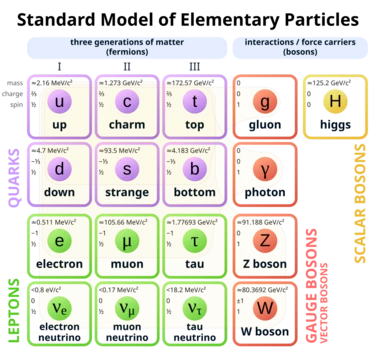
The LHC's goal is to allow physicists to test the predictions of different theories of particle physics, including measuring the properties of the Higgs boson, searching for the large family of new particles predicted by supersymmetric theories, and studying other unresolved questions. The Standard Model was completed by detection of the Higgs boson by the LHC in 2012. LHC collisions have explored questions including: Do all known particles have supersymmetric partners? Are there extra dimensions as predicted by string theory? What is the nature of dark matter? Other questions include whether the electroweak force and strong nuclear force are manifestations of a single unified force, why gravity is so much weaker than the other forces, additional sources of quark flavour mixing, and violations of matter–antimatter symmetry. The nature and properties of quark–gluon plasma are investigated by heavy ion collisions, mainly in ALICE, but also in CMS, ATLAS and LHCb; first observed in 2010, findings published in 2012 confirmed the phenomenon of jet quenching in heavy-ion collisions. Between 2013 and 2015, the LHC was shut down and upgraded; after those upgrades it reached 6.5 TeV per beam (13.0 TeV total collision energy). At the end of 2018, it was shut down for maintenance and further upgrades, and reopened over three years later in April 2022.
Did You Know?
- The LHC tunnel was originally built for the Large Electron–Positron Collider between 1983 and 1988.
- The LHC uses 470 tonnes of niobium-titanium superconductor and 96 tonnes of superfluid helium-4 to cool magnets to 1.9 K.
- Protons in the LHC travel at about 0.999999990 c, only about 3.1 m/s slower than the speed of light.
- Each day of LHC operation generates 140 terabytes of data.
- The LHC's design luminosity of 10³⁴ cm⁻²s⁻¹ was first reached in June 2016, and by 2017 twice that value was achieved.
A Global Engineering Endeavor Beneath the Alps
The Large Hadron Collider represents one of the most ambitious collaborative scientific projects ever undertaken. Between 1998 and 2008, the European Organization for Nuclear Research assembled a workforce exceeding ten thousand scientists, drawing on hundreds of universities and laboratories spread across more than one hundred countries. The machine itself occupies a circular tunnel stretching twenty-seven kilometres in circumference, buried at depths ranging from fifty to one hundred and seventy-five metres beneath the France–Switzerland border near Geneva. The tunnel, a concrete-lined passage 3.8 metres wide, was actually constructed earlier, between 1983 and 1988, to house the predecessor Large Electron–Positron Collider. Engineers deliberately varied the depth along the route to minimize the section running under the Jura Mountains, avoiding the need for a vertical access shaft in that rocky terrain. Burying the ring underground also eliminated the cost of purchasing surface land and leveraged the natural shielding that the overlying rock provides against background radiation. The tunnel crosses the national border at four points, with the majority of its length lying on the French side. Above ground, auxiliary buildings house compressors, ventilation systems, control electronics, and refrigeration plants essential to keeping the superconducting magnets operational.
Milestones, Shutdowns, and the Higgs Revelation
The LHC's operational history is punctuated by dramatic leaps in energy and equally dramatic pauses for upgrades. In 2010, the machine achieved its first collisions at 3.5 tera-electronvolts per beam, roughly quadrupling the previous world record for accelerator energy. Two years later, in 2012, the collider delivered its most celebrated result: the announcement of the Higgs boson discovery, a particle whose detection completed the Standard Model of particle physics. Between 2013 and 2015, the entire ring was taken offline for a major upgrade programme. When it returned to service, each beam carried 6.5 TeV, yielding a total collision energy of 13.0 TeV. The machine then ran until the end of 2018, when it was shut down once more for maintenance and further enhancements. That second long shutdown lasted over three years, and the collider did not reopen until April 2022. Each pause, while costly in lost research time, allowed engineers to push the machine closer to its design limits, ensuring that when the beams collide again, they do so with ever greater precision and energy.
Probing the Deepest Questions in Physics
The LHC was conceived not merely to confirm what physicists already know, but to interrogate the most stubborn open problems in fundamental science. Its collision data can test whether every known particle possesses a supersymmetric partner, a prediction of extensions beyond the Standard Model. It can probe whether extra spatial dimensions exist, as various string-theory models suggest, and whether those dimensions can be detected in collision byproducts. The collider also offers a window into dark matter, the hypothetical substance thought to account for roughly twenty-seven percent of the universe's total mass-energy. Other questions on the agenda include whether the electroweak force and the strong nuclear force are themselves two faces of a single unified interaction, as Grand Unification Theories propose, and why gravity remains so many orders of magnitude weaker than the other three fundamental forces. Heavy-ion collisions, particularly lead–lead and proton–lead events, allow researchers to study quark–gluon plasma, a state of matter believed to have filled the early universe. The LHC also investigates apparent violations of matter–antimatter symmetry and searches for additional sources of quark flavour mixing beyond those already catalogued in the Standard Model.
How the Machine Works: Beams, Magnets, and Detectors
At its core, the LHC is a collider: a device that accelerates two opposing particle beams around a circular ring until they smash together at designated crossing points. The tunnel houses two adjacent parallel beam pipes, each carrying a beam that travels in the opposite direction to its counterpart. The beams intersect at four points around the ring, and it is at these crossings that the physics happens. To keep the particles on their circular trajectory, one thousand two hundred and thirty-two dipole magnets line the ring, while an additional three hundred and ninety-two quadrupole magnets continuously refocus the beams, with the strongest quadrupoles placed near the intersection points to maximize the probability of particle interaction. Nine large detectors, each engineered to capture a different class of physical phenomenon, are positioned around the crossing points to record the debris of each collision. Although the LHC primarily accelerates proton beams, it is also capable of driving heavy-ion beams, enabling lead–lead and proton–lead collision studies. The particles involved are hadrons—composite objects of quarks bound by the strong nuclear force—ranging from familiar baryons like protons and neutrons to mesons such as pions and kaons.
Frequently Asked Questions
Who is Large Hadron Collider?
The Large Hadron Collider is the world's largest and highest-energy particle accelerator, operated by CERN. It sits in a 27-kilometer circular tunnel buried up to 175 meters beneath the France–Switzerland border near Geneva.
What are Large Hadron Collider's powers/role?
Its core function is to accelerate proton beams to up to 6.5 TeV per beam (13.0 TeV combined) and crash them together so physicists can examine the fundamental constituents of matter. The collision debris is analyzed by massive detectors to test predictions about subatomic particles and forces.
How does Large Hadron Collider's story end?
The LHC has no true finale because it is still running and being upgraded, but its most celebrated arc peaked with the 2012 announcement of the Higgs boson. That discovery filled the last missing piece of the Standard Model particle roster and remains the machine's defining achievement.
Why is Large Hadron Collider important?
It is the most powerful instrument ever built to probe fundamental physics, having confirmed the Higgs boson and opened new frontiers in dark matter and beyond-Standard-Model research. Its construction (1998–2008) and continued operation represent a landmark of international scientific collaboration.
When was Large Hadron Collider born?
Construction ran from 1998 to 2008, and the machine produced its first proton-proton collisions in 2010 at 3.5 TeV per beam. It was subsequently upgraded to reach its full design energy of 6.5 TeV per beam.
More in Particle And Nuclear Physics 25-40
Related in Particle And Nuclear Physics
Links follow this subject's own source article.
Elsewhere in the Particle And Nuclear Physics universe
Spotted an error? Know more?
This is a living reference — every entry is fact-audited, and reader corrections feed straight into our audit queue. Suggest an edit · See this site's audit record