Tau (particle)
Third charged lepton, heavier analogue of the electron.

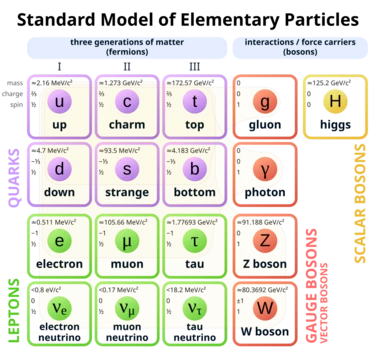
The tau (τ), also called the tau lepton, tau particle or tauon, is an elementary particle similar to the electron, with negative electric charge and a spin of 1/2. It is a lepton, like the electron, muon, and neutrinos, and has a corresponding antiparticle, the antitau (τ+). The tau is the only lepton with enough mass to decay into hadrons, and its discovery confirmed the existence of a third generation of charged leptons.
- type
- Elementary particle
- classification
- Lepton
- lifetime
- 2.9×10⁻¹³ s
- spin
- 1/2
- electric_charge
- -1 e
- symbol
- τ⁻
Lore & Background
The search for the tau began in 1960 at CERN by the Bologna–CERN–Frascati (BCF) group led by Antonino Zichichi, who conceived the idea of a new sequential heavy lepton and invented a method of search. They did not detect the tau directly but discovered 64 anomalous events of the form e⁺ + e⁻ → e± + μ∓ + at least two undetected particles, which they proposed were the production and subsequent decay of a new particle pair: e⁺ + e⁻ → τ⁺ + τ⁻ → e± + μ∓ + 4ν. The mass and spin of the tau were subsequently established by work at DESY-Hamburg with the Double Arm Spectrometer (DASP) and at SLAC-Stanford with the SPEAR Direct Electron Counter (DELCO). The symbol τ was derived from the Greek τρίτον (triton, meaning 'third'), as it was the third charged lepton discovered.
Reader's Guide
The tau lepton is significant as the third charged lepton, completing the lepton family alongside the electron and muon. Its discovery confirmed the existence of a third generation of matter, a key element of the Standard Model of particle physics. Because of its high mass, the tau is the only lepton that can decay into hadrons, providing a unique window into the weak interaction. Its decays, both leptonic and hadronic, have precisely measured branching fractions—such as 17.82% into a tau neutrino, electron, and electron antineutrino, and 25.49% into a charged pion, neutral pion, and tau neutrino—which test lepton universality and the predictions of the Standard Model. The tau's short lifetime (2.9×10⁻¹³ s) means its range is set by decay length, but at ultra-high energies (above petaelectronvolt), time dilation extends its path, giving it penetrating power. The tau's discovery, led by Martin Perl and Yung-su Tsai, was a milestone in particle physics, earning Perl the Nobel Prize.
Did You Know?
- The tau is the only lepton with enough mass to decay into hadrons.
- The symbol τ comes from the Greek τρίτον (triton), meaning 'third', as it was the third charged lepton discovered.
- The tau was not detected directly but inferred from anomalous events of the form e⁺ + e⁻ → e± + μ∓ + at least two undetected particles.
Frequently Asked Questions
What is the tau particle?
The tau (τ) is the third charged lepton, essentially a much heavier cousin of the electron. It carries a negative electric charge, has a spin of 1/2, and sits alongside the electron and muon in the lepton family.
What makes the tau unique among leptons?
Unlike the electron and muon, the tau is massive enough to decay into hadrons (quark-antiquark pairs). This gives it a richer set of decay channels and makes it a key probe of the strong force.
Does the tau have an antiparticle?
Yes—the antitau (τ⁺) is its mirror image, carrying a positive electric charge while sharing the same mass, spin, and lifetime. It behaves as the tau's CP-conjugate partner in interactions.
More in Particle And Nuclear Physics 1-24
Elsewhere in the Particle And Nuclear Physics universe
Spotted an error? Know more?
This is a living reference — every entry is fact-audited, and reader corrections feed straight into our audit queue. Suggest an edit · See this site's audit record