Positron
First antimatter particle, predicted by Dirac, discovered by Anderson.

The positron, also known as the antielectron, is the antiparticle of the electron, possessing an electric charge of +1e, a spin of 1/2 ħ, and the same mass as an electron. When a positron collides with an electron, annihilation occurs, producing two or more photons at low energies.
Lore & Background
Dirac initially misinterpreted these as corresponding to protons, not electrons with both positive and negative charge. Experimental clues began in the late 1920s when Dmitri Skobeltsyn observed tracks in a Wilson cloud chamber that curved opposite to electrons in a magnetic field. Positrons are naturally produced in β+ decays of radioactive isotopes like potassium-40, in interactions of gamma quanta with matter, and in cosmic rays. They are also created in high-temperature environments, such as during baryogenesis in the early universe. The backwards-in-time interpretation, proposed by Ernst Stueckelberg and Richard Feynman, views the positron as an electron moving backward in time.
Reader's Guide
The positron's discovery marked the first evidence of antimatter, fundamentally changing the understanding of particle physics. It confirmed Dirac's theoretical prediction and validated the Dirac equation's negative energy solutions. The positron's existence led to the concept of antiparticles and antimatter, with implications for cosmology, such as the baryon asymmetry problem. Its annihilation with electrons produces gamma rays, a principle used in medical imaging like PET scans. The positron also contributed to the development of quantum electrodynamics and the Feynman-Stueckelberg interpretation of antiparticles as particles moving backward in time. Natural positron production from potassium-40 in the human body results in about 4,000 positrons per day, which annihilate with electrons. The discovery also highlighted the importance of experimental follow-up, as Anderson acknowledged that Chao's earlier work could have led to the discovery. The positron remains a key particle in understanding matter-antimatter symmetry and the early universe.
Did You Know?
- Positrons are naturally produced in the human body from the decay of potassium-40, resulting in about 4,000 positrons per day.
- The term 'positron' was suggested by the editor of the Physical Review journal, not by Anderson.
- Ernst Stueckelberg and Richard Feynman proposed interpreting the positron as an electron moving backward in time.
Identity and Classification in the Standard Model
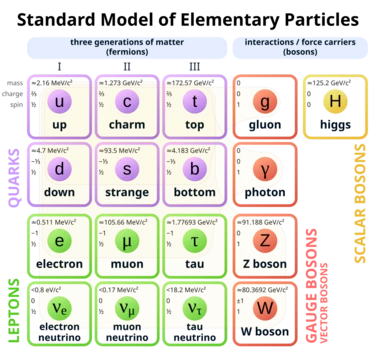
The positron occupies a precise and elegant position within the architecture of fundamental physics. As the antiparticle counterpart to the electron, it shares exactly the same mass as its partner yet carries a positive electric charge where the electron bears a negative one. This mirror relationship is not an anomaly but a structural principle: the Standard Model, which gained broad acceptance in the mid-1970s following experimental confirmation of quarks, accounts for 24 fundamental fermions—twelve particles paired with their twelve associated anti-particles. The positron belongs to the first generation of fermions, the only generation from which ordinary matter is constructed. That first generation also includes up and down quarks, which assemble into protons and neutrons, alongside the electron neutrino. While the photon is unique in being its own antiparticle, the electron-positron pair exemplifies the more common pattern where distinct particles serve as each other's mirror images. This classification framework, now encompassing 61 elementary particles in total, has been found to agree with nearly every experimental test conducted to date.
Antimatter and the Matter-Antimatter Imbalance
The positron is more than a mathematical curiosity; it is the building block of a theoretical realm called antimatter. Because antiparticles carry the same mass as their particle counterparts but bear opposite electric charges, they can in principle assemble into a corresponding form of matter. The electron's negative charge is matched by the positron's positive charge, and this symmetry sits at the heart of the Standard Model's description of the three known fundamental interactions—electromagnetism, the weak interaction, and the strong interaction—each mediated by gauge bosons. Yet the observable universe is overwhelmingly composed of matter rather than antimatter, a puzzle sharpened after James Cronin and Val Fitch demonstrated CP violation, raising profound questions about the matter-antimatter imbalance. The Standard Model, while extraordinarily successful and found to agree with almost all experimental tests conducted to date, is regarded by most particle physicists as an incomplete description of nature. The reconciliation of gravity with the current particle physics framework remains unsolved, with candidates such as loop quantum gravity, string theory, and supersymmetry theory all attempting to close the gap.
The Particle Zoo and the Road to Order
For decades after the early twentieth century, particle physics accumulated discoveries at a dizzying pace. Throughout the 1950s and 1960s, collisions of particles from beams of increasingly high energy revealed a bewildering variety of new species, a collection physicists informally dubbed the particle zoo. The positron, as the electron's antiparticle counterpart, was one thread in this tangled web. The situation transformed after the Standard Model was formulated during the 1970s, gaining widespread acceptance following experimental confirmation of quarks. The large number of observed particles was reinterpreted as combinations of a relatively small set of more fundamental constituents, framed within quantum field theories. This reordering of the particle landscape is widely regarded as the starting point of modern particle physics. In its current formulation, the Standard Model enumerates 61 elementary particles, which in turn assemble into composite particles and thereby account for the hundreds of additional species identified since the 1960s. On 4 July 2012, physicists at the Large Hadron Collider at CERN announced the detection of a new particle behaving similarly to the expected Higgs boson—one that had been postulated theoretically before experimental confirmation, illustrating the deep interrelation between theoretical and experimental particle physics.
Quantum Fields and the Limits of Current Theory
The positron, like all elementary particles, is understood as an excitation of an underlying quantum field, and its interactions are likewise governed by those fields. The dynamics of such particles are further shaped by quantum mechanics, which endows them with wave-particle duality: they display particle-like behaviour under certain experimental conditions and wave-like behaviour under others. The dominant theoretical framework explaining these fundamental particles, their fields, and their dynamics is the Standard Model, which describes the strong, weak, and electromagnetic interactions using mediating gauge bosons—eight gluons, W−, W+, and Z bosons, and the photon. Yet the model carries known limitations. In recent years, measurements of neutrino mass have provided the first experimental deviations from the Standard Model, since neutrinos are predicted to be massless within that framework. Most particle physicists believe a more fundamental theory awaits discovery. The reconciliation of gravity with current particle physics remains an open problem, with loop quantum gravity, string theory, and supersymmetry theory among the candidates addressing this challenge. The positron thus sits at the intersection of what is firmly established and what remains deeply unresolved.
Frequently Asked Questions
What exactly is a positron?
A positron is the antimatter twin of the electron, carrying a positive charge of +1e while sharing the electron's mass and spin-1/2 quantum number. It is also widely referred to as the antielectron.
What happens when a positron collides with an electron?
The two particles undergo total annihilation, converting their combined rest mass into energy released as two or more gamma-ray photons. At low collision energies, exactly two photons are typically emitted in opposite directions to conserve momentum.
Why does the positron matter in the history of physics?
It stands as the very first confirmed piece of antimatter, proving that a fundamental particle can have a corresponding antiparticle. Its discovery opened the entire field of antimatter research and reshaped how physicists think about particle-antiparticle symmetry.
More in Particle And Nuclear Physics 25-40
Elsewhere in the Particle And Nuclear Physics universe
Spotted an error? Know more?
This is a living reference — every entry is fact-audited, and reader corrections feed straight into our audit queue. Suggest an edit · See this site's audit record