Supersymmetry
A theoretical symmetry between bosons and fermions, unconfirmed by experiment.

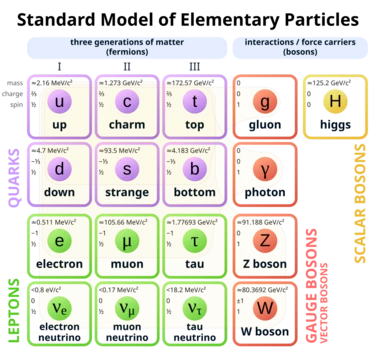
Supersymmetry is a theoretical framework in physics that proposes a symmetry between particles with integer spin (bosons) and particles with half-integer spin (fermions). It suggests that for every known particle, there exists a partner particle with different spin properties, and if evidence is found, it could help explain phenomena such as the nature of dark matter and the hierarchy problem in particle physics. Despite multiple experiments, no evidence has been found that supersymmetry exists in nature.
- field
- Theoretical physics, particle physics
- known_for
- Proposing a symmetry between bosons and fermions, superpartner particles, and extensions of the Standard Model
- key_developers
- Pierre Ramond, John H. Schwarz, André Neveu, Julius Wess, Bruno Zumino, Abdus Salam, Pierre Fayet
- status
- Not experimentally verified; some physicists argue the theory is dead
Lore & Background
L. Gervais and B. Sakita, Yu. A. Golfand and E. P. V. Volkov and V. P. Akulov, in the context of quantum field theory. Schwarz, and André Neveu. In 1974, Julius Wess and Bruno Zumino identified the characteristic renormalization features of four-dimensional supersymmetric field theories, and they, along with Abdus Salam and others, introduced early particle physics applications. The term 'supersymmetry' was coined by Abdus Salam and John Strathdee in 1974 as a simplification of 'super-gauge symmetry'.
Reader's Guide
Supersymmetry remains a vital part of many proposed theories in physics, with applications ranging from quantum mechanics and statistical mechanics to quantum field theory, condensed matter physics, nuclear physics, optics, stochastic dynamics, astrophysics, quantum gravity, and cosmology. In high-energy physics, a supersymmetric extension of the Standard Model is a possible candidate for physics beyond the Standard Model, but no such extension has been experimentally verified. The mathematical structure of supersymmetry, based on graded Lie superalgebras, has been applied successfully to topics such as nuclear physics, critical phenomena, and statistical physics. However, the lack of experimental evidence has led some physicists to argue the theory is dead, and the Coleman–Mandula theorem's limitations were overcome by the Haag–Łopuszański–Sohnius theorem, which analyzed all possible superalgebras. Supersymmetry's significance lies in its potential to unify spacetime and internal symmetries and to solve problems like the hierarchy problem and dark matter, though it remains unconfirmed.
Did You Know?
- The term 'supersymmetry' was coined by Abdus Salam and John Strathdee in 1974 as a simplification of 'super-gauge symmetry'.
- Multiple experiments on supersymmetry have failed to provide evidence that it exists in nature.
Frequently Asked Questions
Who is Supersymmetry?
Supersymmetry is a theoretical symmetry principle in particle physics that pairs every boson with a fermionic superpartner and every fermion with a bosonic one. It was first proposed in the 1960s–70s by several independent groups, including Miyazawa, Gervais and Sakita, Gol'fand and Likhtman, and Volkov and Akulov.
What are Supersymmetry's powers and role?
Its core function is to extend the Standard Model by introducing a partner particle for each known particle whose spin differs by half a unit. This extension is designed to address open puzzles such as the hierarchy problem and to supply a natural dark-matter candidate in the form of the lightest superpartner.
How does Supersymmetry's story end?
As of now, no experiment—including those at the LHC—has detected any superpartner, so the theory remains unconfirmed. Some physicists have begun arguing that the simplest supersymmetric models are effectively ruled out, though the broader framework has not been formally discarded.
Why is Supersymmetry important?
It offers a mathematically elegant way to stabilize the Higgs mass against quantum corrections and to unify forces, making it one of the most studied extensions of the Standard Model. Even without experimental confirmation, it has driven decades of theoretical progress in string theory, cosmology, and quantum field theory.
Who are Supersymmetry's key developers?
Beyond the original proposers, the framework was shaped in the 1970s by Pierre Ramond, André Neveu, John Schwarz, Julius Wess, Bruno Zumino, Abdus Salam, and Pierre Fayet. Their collective work turned a loose symmetry idea into a full quantum field theory and later into the foundation of superstring theory.
More in Particle And Nuclear Physics 25-40
Elsewhere in the Particle And Nuclear Physics universe
Spotted an error? Know more?
This is a living reference — every entry is fact-audited, and reader corrections feed straight into our audit queue. Suggest an edit · See this site's audit record