Quantum field theory
Framework combining field theory, relativity, and quantum mechanics.

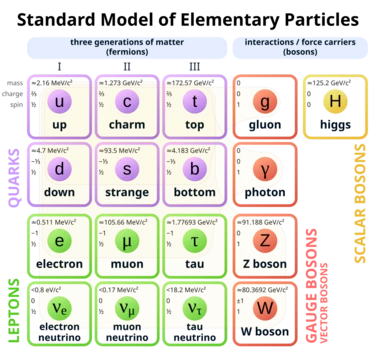
Quantum field theory (QFT) is a theoretical framework in physics that combines classical field theory, special relativity, and quantum mechanics. It is used in particle physics to construct models of subatomic particles and in condensed matter physics to model quasiparticles, and it forms the basis of the current Standard Model of particle physics.
- field
- Theoretical physics
- known_for
- Combining field theory, special relativity, and quantum mechanics; basis of the Standard Model
Lore & Background
Quantum field theory emerged from the work of generations of theoretical physicists spanning much of the 20th century. Its development began in the 1920s with the description of interactions between light and electrons, culminating in the first quantum field theory—quantum electrodynamics. A major obstacle soon followed with infinities in perturbative calculations, resolved in the 1950s with the invention of renormalization. A second barrier came with QFT's apparent inability to describe weak and strong interactions, leading some theorists to call for abandoning the field theoretic approach. The development of gauge theory and the completion of the Standard Model in the 1970s led to a renaissance of quantum field theory. The theoretical background of QFT includes classical field theory, quantum mechanics, and special relativity. Classical field theory began with Newton's law of universal gravitation, though fields were initially considered a mathematical trick.
Reader's Guide
Quantum field theory is significant as the theoretical framework underlying the Standard Model of particle physics, which describes subatomic particles and their interactions. The theory overcame major obstacles: infinities in calculations were addressed by renormalization in the 1950s, and the inability to describe weak and strong interactions was resolved by gauge theory and the completion of the Standard Model in the 1970s. QFT also applies to condensed matter physics for modeling quasiparticles. Its legacy includes unifying quantum mechanics and special relativity, and providing a consistent description of electromagnetic, weak, and strong forces. The theory's development involved contributions from many physicists over decades, and it remains central to modern physics.
Did You Know?
- Quantum field theory emerged from the work of generations of theoretical physicists spanning much of the 20th century.
- The first quantum field theory was quantum electrodynamics, developed in the 1920s.
- A major obstacle in QFT was the appearance of infinities in perturbative calculations, resolved in the 1950s with renormalization.
- The development of gauge theory and the completion of the Standard Model in the 1970s led to a renaissance of quantum field theory.
Frequently Asked Questions
Who is Quantum field theory?
QFT is the overarching theoretical framework in particle physics that unifies classical field theory, special relativity, and quantum mechanics into a single coherent structure. It serves as the foundational language for describing subatomic particles and their interactions.
What are Quantum field theory's powers/role?
QFT constructs the mathematical models behind the Standard Model of particle physics and also describes quasiparticles in condensed matter systems. It lets physicists predict how particles are created, destroyed, and interact at the deepest accessible level.
How does Quantum field theory's story end?
QFT has no narrative ending—it remains the active, evolving backbone of modern theoretical physics. Its ongoing frontier involves reconciling it with quantum gravity and extending beyond the Standard Model.
Why is Quantum field theory important?
Without QFT, the Standard Model of particle physics would have no mathematical foundation, and we could not systematically describe how fundamental forces operate. It is the indispensable bridge between quantum mechanics and relativistic field descriptions.
What does Quantum field theory combine?
It weaves together three pillars—classical field theory, special relativity, and quantum mechanics—into one unified formalism. This synthesis is what allows it to describe particles as excitations of underlying quantum fields moving through spacetime.
More in Particle And Nuclear Physics 25-40
Elsewhere in the Particle And Nuclear Physics universe
Spotted an error? Know more?
This is a living reference — every entry is fact-audited, and reader corrections feed straight into our audit queue. Suggest an edit · See this site's audit record