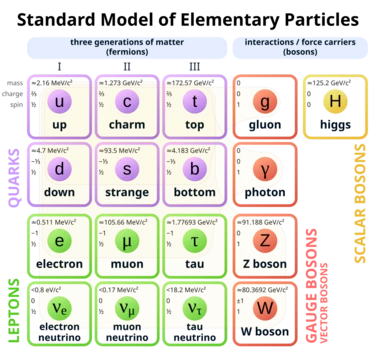
Spin (physics)
Intrinsic quantized angular momentum of elementary particles.

Spin is an intrinsic form of angular momentum carried by elementary particles, and thus by composite particles such as hadrons, atomic nuclei, and atoms. It is quantized, and accurate models for the interaction with spin require relativistic quantum mechanics or quantum field theory. The existence of electron spin angular momentum is inferred from experiments, such as the Stern–Gerlach experiment, in which silver atoms were observed to possess two possible discrete angular momenta despite having no orbital angular momentum.
- field
- Quantum mechanics, particle physics
- known_for
- Intrinsic angular momentum of particles, spin quantum number, spin–statistics theorem
- SI_units
- N·m·s, J·s, or kg·m²·s⁻¹
- quantum_number_values
- Half-integer or integer (0, 1/2, 1, 3/2, 2, ...)
- key_experiment
- Stern–Gerlach experiment
Lore & Background
The earliest models for electron spin imagined a rotating charged mass, but this model fails when examined in detail. The required space distribution does not match limits on the electron radius, and the required rotation speed exceeds the speed of light. In the Standard Model, fundamental particles are considered point-like, and any model for spin based on mass rotation would need to be consistent with that model. Wolfgang Pauli initially rejected any idea that the degree of freedom he introduced was related to rotation, calling it 'classically non-describable two-valuedness'. Later, he allowed that it is related to angular momentum but insisted on considering spin an abstract property, which allowed him to develop a proof of the Pauli exclusion principle, now called the spin–statistics theorem.
Reader's Guide
Spin is a fundamental property of particles that has no classical analog, though it obeys the mathematical laws of angular momentum quantization. The spin quantum number s can take half-integer or integer values, and for a given elementary particle, the magnitude of spin cannot be changed, only its direction. The spin–statistics theorem connects electron spin quantization to the Pauli exclusion principle: observations of exclusion imply half-integer spin, and observations of half-integer spin imply exclusion. Spin is described mathematically as a vector for some particles such as photons, and as a spinor for other particles such as electrons. In practice, spin is usually given as a dimensionless spin quantum number by dividing the spin angular momentum by the reduced Planck constant ħ. The concept of spin has been interpreted in various ways, including as a wave property generated by a circulating flow of charge in the wave field of the electron, and in the de Broglie–Bohm interpretation as a property of the pilot wave rather than the particle itself.
Did You Know?
- The Stern–Gerlach experiment showed silver atoms possess two possible discrete angular momenta despite having no orbital angular momentum.
- Wolfgang Pauli called spin a 'classically non-describable two-valuedness' before accepting it as angular momentum.
- Spin quantum numbers may take either half-integer or integer values.
- The SI units of spin are the same as classical angular momentum: N·m·s, J·s, or kg·m²·s⁻¹.
Frequently Asked Questions
Who is Spin (physics)?
Spin is the built-in angular momentum that every elementary particle carries as a fundamental part of its identity, entirely independent of any motion through space. It also appears in composite systems like nuclei and atoms, where the individual particle spins add up to give the whole object its total spin value.
What are Spin (physics)'s powers and role?
Spin is strictly quantized, taking only integer or half-integer multiples of ħ, and it dictates how particles couple to magnetic fields and interact with one another. The spin–statistics theorem further locks a particle's spin value to whether it behaves as a boson or a fermion, shaping the entire architecture of matter and forces.
How does Spin (physics)'s story end?
Spin has no narrative ending because it is an immutable, intrinsic attribute of a particle's identity; an electron's spin-½ never changes no matter what environment it is placed in. What can change is the orientation or total spin of a multi-particle system through interactions, but the fundamental quantum number of each particle remains fixed for its entire existence.
Why is Spin (physics) important?
Without spin, atomic structure, magnetism, the Pauli exclusion principle, and the distinction between matter particles and force carriers would all be unexplainable. It sits at the heart of quantum mechanics, condensed-matter physics, and the Standard Model, making it arguably the single most consequential intrinsic property a particle can carry.
More in Particle And Nuclear Physics 25-40
Elsewhere in the Particle And Nuclear Physics universe
Spotted an error? Know more?
This is a living reference — every entry is fact-audited, and reader corrections feed straight into our audit queue. Suggest an edit · See this site's audit record