Quantum chromodynamics
Quantum field theory of the strong force binding quarks.

Quantum chromodynamics (QCD) is the theoretical framework in particle physics that describes the strong interaction, the force that binds quarks together inside hadrons such as protons, neutrons, and pions. It is a non-abelian gauge theory based on the symmetry group SU(3), with gluons as the force carriers and a property called color charge as the analog of electric charge. QCD is a cornerstone of the Standard Model of particle physics, supported by extensive experimental evidence.
- field
- Theoretical physics
- known_for
- Strong interaction, color confinement, asymptotic freedom, chiral symmetry breaking
- symmetry_group
- SU(3)
- force_carriers
- Gluons
Lore & Background
The development of QCD emerged from the need to explain the growing number of hadrons discovered in the 1950s and 1960s. A problem arose: certain baryons, such as the Ω− and Δ++, seemed to require three identical quarks with parallel spins, violating the Pauli exclusion principle. Boris Struminsky, advised by Nikolay Bogolyubov, suggested in a preprint that quarks must possess an additional quantum number. In 1964–65, Oscar W. Greenberg, and Moo-Young Han and Yoichiro Nambu independently proposed that quarks carry an additional SU(3) gauge degree of freedom, later named color charge. Han and Nambu also noted that quarks might interact via an octet of vector gauge bosons—the gluons.
Reader's Guide
Quantum chromodynamics is significant because it provides the fundamental theory of the strong nuclear force, one of the four known fundamental forces. Its three salient properties—color confinement, asymptotic freedom, and chiral symmetry breaking—explain why quarks are never found in isolation, why the force weakens at high energies, and why hadron masses are much larger than the sum of their constituent quark masses. Chiral symmetry breaking, elucidated by Yoichiro Nambu (2008 Nobel Prize), explains the lightness of pseudoscalar mesons. Despite its successes, color confinement remains mathematically unproven, and proving it is one of the Clay Mathematics Institute's Millennium Prize Problems. QCD also predicts exotic phases of quark matter, including the quark–gluon plasma.
Did You Know?
- The word 'quark' was coined by Murray Gell-Mann, inspired by the phrase 'Three quarks for Muster Mark' from James Joyce's Finnegans Wake.
- The three kinds of color charge in QCD are loosely analogous to the three colors red, green, and blue, but are completely unrelated to everyday color.
- The force between quarks is called the colour force or strong interaction, and is responsible for the nuclear force.
The Strong Force and the Imprisonment of Quarks
The strong interaction stands as one of the three fundamental forces in nature, alongside electromagnetism and the weak interaction, each carried by its own family of boson particles. What makes the strong force distinctive is its absolute grip on quarks: these fundamental building blocks can never be observed in isolation. Instead, they are permanently bound into composite structures called hadrons. When an odd number of quarks clusters together, the result is a baryon; an even number yields a meson. The proton and the neutron, both baryons, account for the vast majority of the mass we encounter in everyday matter. Mesons, by contrast, are inherently fleeting—the longest-lived among them survive for mere hundredths of a microsecond before decaying. They appear in the aftermath of high-energy collisions, whether in the natural bombardment of cosmic rays striking Earth's atmosphere or in the controlled environments of cyclotrons and other particle accelerators. This permanent confinement of quarks is the defining signature of the strong interaction and the central puzzle that quantum chromodynamics was built to explain.
Eight Gluons and the Architecture of the Strong Force
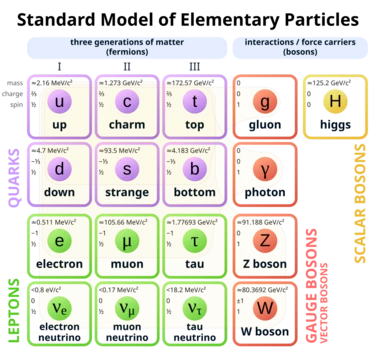
Within the Standard Model's elegant taxonomy, the strong interaction is carried by a specific set of eight gauge bosons known as gluons. These sit alongside the W-minus, W-plus, and Z bosons that mediate the weak force, and the photon that carries electromagnetism, forming the complete roster of force-carrying particles in the theory. The Standard Model as a whole enumerates sixty-one elementary particles, a number that includes twenty-four fundamental fermions—twelve matter particles paired with their corresponding antiparticles. These fermions are organized into three generations, though only the first generation, comprising up and down quarks along with electrons and electron neutrinos, assembles the ordinary matter around us. The sixty-one elementary particles are not the full cast of the subatomic world; they combine into composite structures that account for the hundreds of additional particle species discovered since the 1960s. Every one of these composites, from the humblest meson to the most exotic baryon, ultimately traces its existence back to the interplay of quarks bound by gluon exchange, the very mechanism that quantum chromodynamics describes.
Taming the Particle Zoo
During the 1950s and 1960s, particle physicists faced an overwhelming flood of new discoveries. As beam energies in accelerators climbed ever higher, collisions revealed a bewildering array of previously unknown particles, a situation that earned the informal nickname the particle zoo. The sheer volume of these species made it nearly impossible to discern any underlying order. The breakthrough came with the formulation of the Standard Model during the 1970s, which gained widespread acceptance after experimental confirmation of quarks in the mid-1970s. The theory reframed the entire zoo: what had appeared as hundreds of independent entities were, in fact, combinations of a relatively small set of more fundamental particles, all organized within the framework of quantum field theories. This reclassification transformed a confusing catalogue into a coherent taxonomy and is widely regarded as the true beginning of modern particle physics. The strong interaction, described by quantum chromodynamics, provided the crucial glue—literally, through its gluon mediators—that explained why quarks cluster into the specific baryon and meson patterns observed in every high-energy collision.
QCD in an Incomplete Universe
Quantum chromodynamics occupies a central pillar within the Standard Model, which has been found to agree with virtually every experimental test conducted to date. The theory's predictions have been spectacularly validated, from the confirmation of quarks in the mid-1970s to the 2012 announcement by physicists at CERN's Large Hadron Collider that a new particle behaving like the long-postulated Higgs boson had been detected. Yet most particle physicists regard the Standard Model, and QCD within it, as an incomplete description of nature. The first concrete experimental deviation emerged from measurements of neutrino mass, since the Standard Model in its current form assigns no mass to neutrinos. Beyond that, the reconciliation of gravity with the quantum framework remains an open problem, with candidates such as loop quantum gravity, string theory, and supersymmetry theory all attempting to bridge the gap. All particles, including the gluons of QCD, are understood as excitations of underlying quantum fields, and the interplay between theoretical prediction and experimental verification—exemplified by the Higgs boson's journey from postulation to detection—continues to drive the field forward.
Frequently Asked Questions
Who is Quantum Chromodynamics?
QCD is the quantum field theory that governs the strong nuclear force, describing how quarks are held together inside protons, neutrons, and pions. It operates as a non-abelian gauge theory built on the SU(3) symmetry group, with gluons serving as its force-carrying messengers.
What are Quantum Chromodynamics's powers/role?
QCD's signature abilities include color confinement (quarks can never be isolated) and asymptotic freedom (quarks interact weakly at very short distances). It also drives chiral symmetry breaking, which generates most of the visible mass in the universe.
How does Quantum Chromodynamics's story end?
QCD has no narrative ending—it remains an active, ongoing pillar of the Standard Model with no known final resolution. Its non-perturbative regime at low energies still resists exact analytical solutions, so the story continues through lattice simulations and new experimental probes.
Why is Quantum Chromodynamics important?
Without QCD, protons and neutrons would not exist, and therefore no atoms, stars, or chemistry could form. It is the theoretical backbone explaining how the vast majority of visible mass in the universe emerges from the strong interaction rather than from the Higgs mechanism.
More in Particle And Nuclear Physics 25-40
Elsewhere in the Particle And Nuclear Physics universe
Spotted an error? Know more?
This is a living reference — every entry is fact-audited, and reader corrections feed straight into our audit queue. Suggest an edit · See this site's audit record